
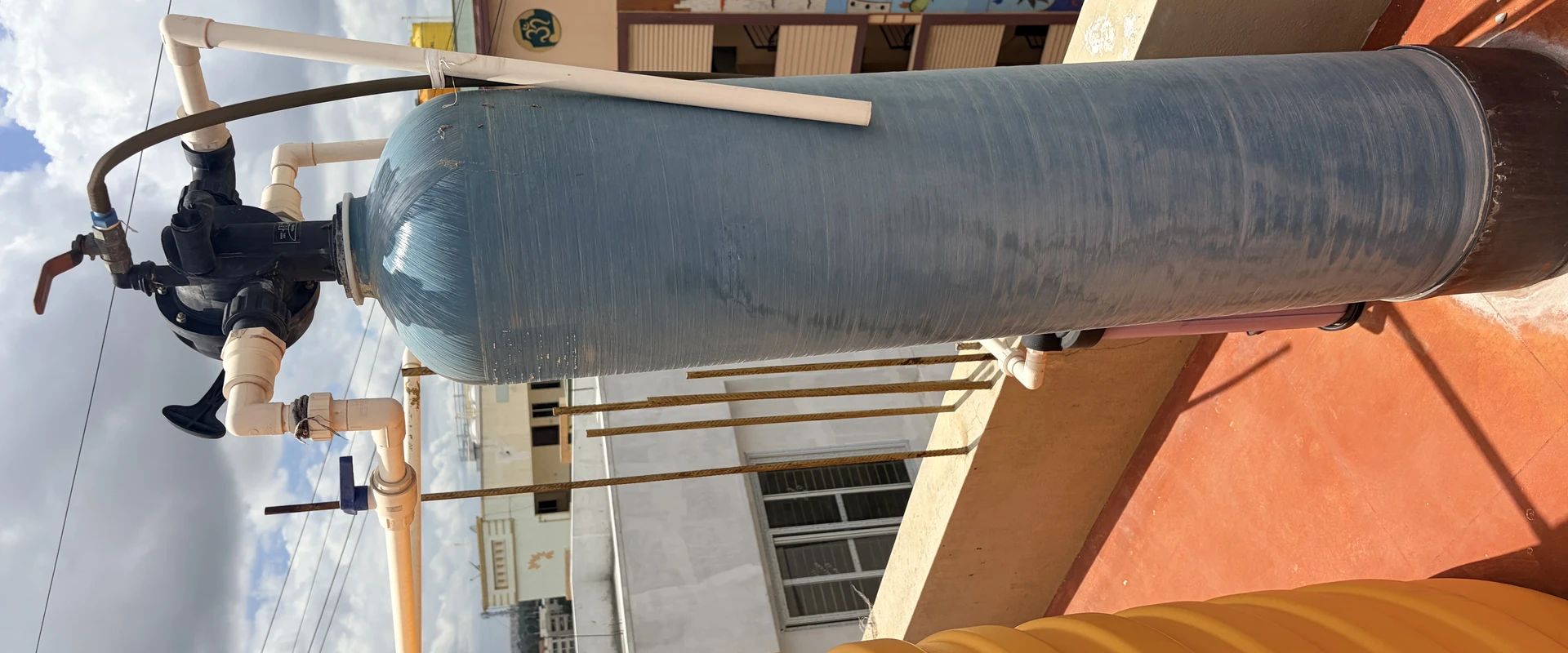
Softener, filter or reverse osmosis: what each one does
These three get mixed up all the time, and buying the wrong one is the most common mistake. They treat different things.
A water softener uses ion exchange. Water passes through a tank of resin beads that hold sodium or potassium ions. As hardness minerals, calcium and magnesium, pass by, the beads grab them and release the other ion in exchange. The result is softened water that leaves less scale on fixtures and in the water heater.
A whole-house filter uses sediment and carbon media. Sediment filters catch sand and particles. Carbon filters reduce chlorine taste and odor and some other compounds. A reverse osmosis system pushes water through a very fine membrane at one tap, usually under the kitchen sink, and gives a small supply of drinking water.
| System | What it does | What it does not do |
|---|---|---|
| Water softener | Removes calcium and magnesium that cause scale and soap film | Does not remove chlorine taste or odor and is not a drinking water purifier |
| Whole-house filter | Catches sediment and, with carbon, reduces chlorine taste and odor at every tap | Does not soften the water |
| Reverse osmosis | Treats drinking and cooking water at one tap with a fine membrane | Does not treat the whole house, and it wastes some water to drain |
First find out what is in your water
Before choosing equipment, find out what your water contains. We do not have a hardness figure for Cibolo water, and none appears in the reports we have seen, so we do not call it hard or soft. Test your tap with a hardness test kit, or ask a lab. Ask your water utility for its annual water quality report too.
Supply can differ from one address to another. According to the City of Cibolo, it buys nearly all its water from Canyon Regional Water Authority, which draws on Wells Ranch groundwater from the Carrizo-Wilcox aquifers and surface water from Lake Dunlap. Two utilities serve the area, the City and Green Valley Special Utility District, and which one serves a home depends on the address. The bill names it.
That is why a test at your own tap beats a guess about the neighborhood. A test in the kitchen tells you more about your house than any area average.
Chlorine taste is a filter job
Many people ask about a softener when what bothers them is the taste or smell of chlorine. A softener does not fix that. A carbon filter does.
Public water carries a chlorine residual. According to the 2025 consumer confidence report for the City of Cibolo, chlorine residual averaged 2.26 ppm for the Wells Ranch supply and 1.70 ppm for the Schertz supply. GVSUD reported 1.68 ppm. Those numbers show disinfection. A chlorine taste alone is not a sign of a problem, but report other changes to your utility. If the taste bothers you, a carbon filter at the tap or on the whole house reduces it.
Because the supply differs by address, check which figure applies to you in your utility's report.
Sizing and installing a softener
A softener is sized to the household and the water. Bigger families and more minerals mean more resin and more frequent regeneration. A unit that is too small regenerates too often and wastes salt, and one that is too big can sit idle and let water stagnate in the tank.
Installation has a few fixed requirements. The unit needs a bypass valve so water can reach the house while the unit is serviced. It needs a drain, because regeneration flushes salty water out of the tank, and an air gap or proper connection so wastewater cannot back up. It needs an electrical outlet nearby for the control head. And it needs a spot on a level floor with room to add salt.
The plumber also decides where it tees into the line. A softener normally treats the whole house, though outdoor taps and some cold-water lines can be left on untreated water. If the hot water side matters most to you, the water heater is covered under installing the water heater.
Need a softener installed or fixed?
Call the 24/7 line and describe the equipment. A licensed plumber is scheduled, and you hear the price first.
A softener that stopped softening
The most common complaint is a softener that no longer softens. Usually the cause is simple.
- The brine tank is out of salt, or a salt bridge has formed
- The brine line or injector is clogged
- The control valve is not cycling, or its power has failed
- The resin beads are worn out and cannot hold minerals
- The bypass valve was left open
A salt bridge is a hard crust that forms in the brine tank, leaving an empty space below it. The salt above never reaches the water, so no brine is made. Breaking the crust with a broom handle and clearing it often fixes the problem. Tanks that stand for years also get a mushy layer at the bottom that a plumber can clean out.
Resin eventually wears. Resin beads commonly last for many years, but they can be damaged by high chlorine over time and by iron. If the control valve is stuck or the resin is spent, the plumber tells you whether to replace the part or the whole unit.
Servicing and repairing existing systems
Water conditioners need attention just like a water heater does. Plumbers work on the control valve, the brine tank, the injector and the resin tank, and they can reinstall a unit after a move or a remodel.
Common jobs include replacing a failed control valve, clearing a clogged injector, cleaning out the brine tank and replacing a leaking fitting or bypass valve. An overflow from the brine tank, where water runs onto the floor, usually points to a fault in the brine valve, the float or the drain line. If an item has fallen into the brine well, such as a tool or a cutter, the plumber can retrieve it, which is easier with the unit off.
A leaky connection near the softener is worth a look, and so is a refrigerator water line valve or ice maker supply that shares the same wall. When a wet spot has no clear source, a leak detection visit can track it down. If water is running from a softener now, shut the water off at the unit's bypass or at the main valve and call.
Sodium or potassium salt
Softeners can use either sodium chloride or potassium chloride. Sodium chloride, the usual salt, is cheaper and widely available. Potassium chloride costs more and is used by people who want to limit sodium, or by those who must follow a diet with low sodium.
Both work by the same ion exchange. If you are on a low-sodium diet, ask your doctor, not a plumber, whether softened water matters for you. Many people install a reverse osmosis tap for drinking water in addition, since it treats the water you actually drink and cook with.
Water treatment and a home purchase
Buying a house with a softener or filter means asking a few questions. When was the resin last serviced? Is the salt level right? Does the control valve cycle? A plumber can inspect the unit, check the bypass, look for leaks and test the output, so you know if the equipment works or comes with a repair bill.
If you are also checking the home's drain line, a camera visit is covered on the sewer camera inspection page.
What affects the price of softener and filter work
Type of system
A softener, a whole-house filter and an under-sink unit are different jobs.
Insurance usually does not cover the cost of buying or installing treatment equipment. A policy may cover sudden water damage from a failed fitting, so ask your insurer. You get a clear price before work starts. The City of Cibolo enforces the 2021 International Plumbing Code (IPC), and permit rules vary, so ask the City of Cibolo building department about permits for plumbing changes.
Before the plumber comes
Check your bill
Note whether the City or GVSUD supplies you, and pull up that utility's latest water quality report.
Test your tap
Use a hardness test kit or send a sample to a lab, and write down the result.
Locate the equipment
Clear the space around the softener and know where its bypass valve and drain are.
Note the symptoms
Write down when the softener last regenerated, the salt level and what changed.
Treatment equipment around Cibolo
We also dispatch for treatment work in nearby towns such as Schertz. The same advice about testing the tap applies there, since supply can differ by address and a test at your own tap is the only sure guide.
If the water heater is the thing that scales up, a softener may help, but check the heater first. See repairing a failing tank when the tank itself is failing. A tankless water heater is more sensitive to scale, so treat the water before you buy one. Larger jobs, including a new line for a filter, fall under general plumbing installation.
Common questions about water softeners and filtration
We do not have a hardness figure for Cibolo water, so we do not say. Test your tap with a hardness test kit, or ask a lab. Your utility's annual water quality report gives other measurements.
No. A softener removes calcium and magnesium. A carbon filter reduces the taste and smell of chlorine.
It is a hard crust in the brine tank that leaves an empty space below it. The softener then makes no brine and stops softening. Breaking it up and clearing the tank usually fixes it.
Not necessarily. Reverse osmosis treats the drinking water at one tap. Many people add one because they want filtered drinking water, or because softened water has added sodium or potassium.
Often yes. A plumber can look at the control valve, brine tank and resin. The dispatcher confirms whether your brand and model fit when you call.
The one on your bill, which depends on your address. Both the City and GVSUD publish annual water quality reports.