
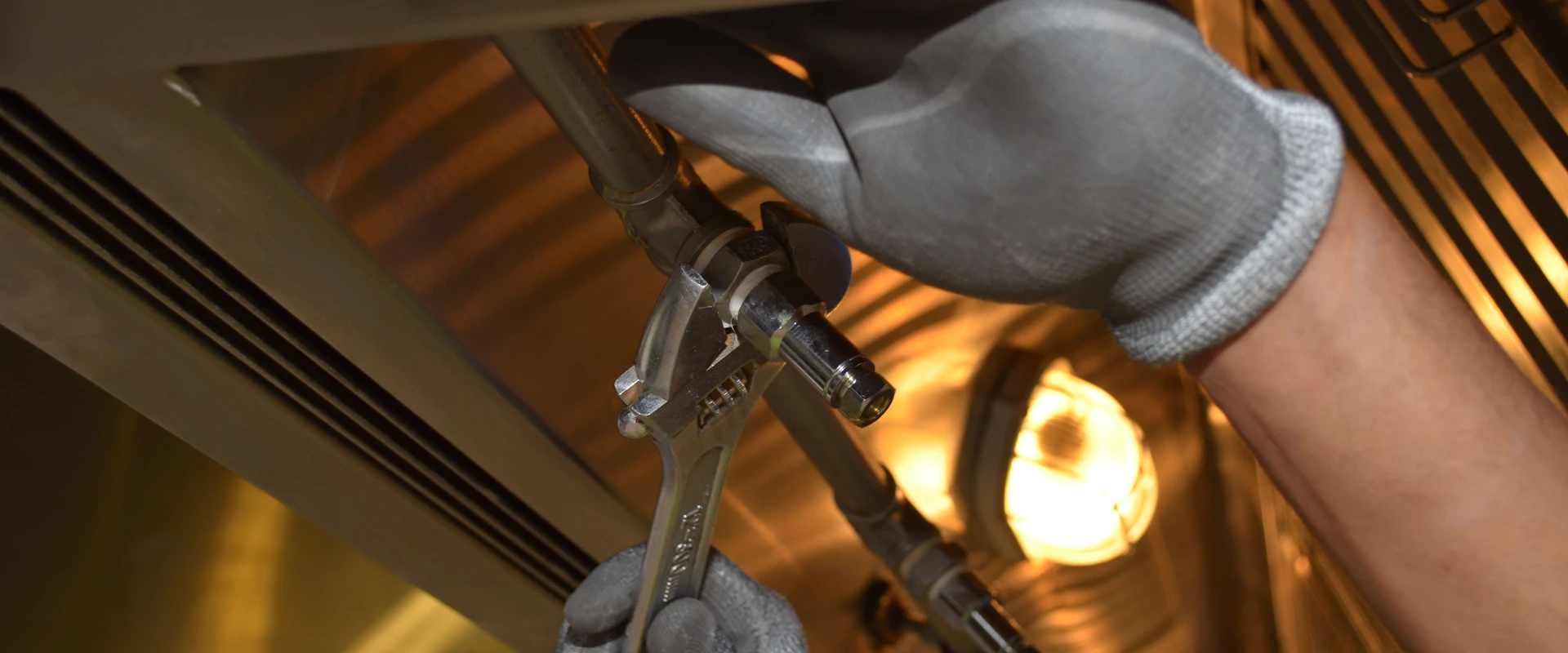
The first five minutes of a burst pipe
What you do before the plumber arrives decides how much of the house gets wet. The goal is simple. Stop the flow, drop the pressure in the pipes, keep people safe and record the damage. Work through these in order.
Close the main water valve
It is usually where the water line enters the house, at an outside hose bib wall, in a garage, or in a utility closet near the water heater. A round handle turns clockwise until it stops. A lever handle turns a quarter turn so it sits across the pipe.
Drain the pressure
With the main closed, open a faucet at the lowest point of the house, such as an outside spigot or a ground-floor tub. Gravity pulls the water still in the pipes out through that tap and the leak slows.
Cut power only if it is dry
If water is near outlets, appliances or the breaker panel, turn off power at the panel, but only if the floor around the panel is completely dry. If you would have to stand in water to reach it, do not go near it and tell the dispatcher.
Move belongings and take photos
Lift rugs, electronics and boxes off the floor. Photograph the damage and the broken pipe before you clean up, since your insurer will ask for pictures.
If you cannot find the main valve, call anyway. The dispatcher can talk you through where it usually sits and what to try next. Do not use a wrench on a valve that will not move. A seized valve that snaps can make a bad situation worse.
When a burst pipe is an emergency
Treat it as an emergency whenever water is flowing and you cannot stop it, whenever it is coming through a ceiling or wall, or whenever it is near electrical equipment. A split pipe can release many gallons a minute, and drywall, insulation and flooring soak up water fast. Every hour matters for the materials around the pipe.
Our line is open nights, weekends and holidays, and a licensed plumber is dispatched for same-day appointments when available. We do not promise an arrival time, but we do tell you what to do in the meantime and what the repair will cost before work starts.
A small drip at a joint under a sink is different. If you can close the angle stop under that sink and the leak stops, it can usually wait for a daytime visit. If the leak keeps going or the pipe is behind a wall, call right away.
Why pipes burst
Freezing is one cause, but it is not the only one. Water expands when it turns to ice, and the pressure inside a sealed section of pipe can split the wall. The crack often shows up when the ice melts and flow returns, not while the pipe is frozen. If you think a pipe froze, close the main before you thaw anything.
Corrosion is the slow cause. Steel and galvanized pipe rust from the inside, and copper can develop pinholes where the water chemistry or flow wears the wall thin. The pipe looks fine until one thin spot gives way.
Pressure is a third cause. A failed pressure reducing valve or a sudden surge when a valve slams shut can push weak spots past their limit.
Fittings are the fourth cause. A solder joint, a crimped connector or a threaded elbow can fail on its own without any problem in the pipe itself. And a damaged line, from a nail, a shovel or a settling slab, can split with no warning.
Utility events are not the same as a pipe break
In February 2021, the City of Cibolo issued a boil water notice for its Upper Pressure Zone after distribution pressure dropped, as required by TCEQ. That was a utility event on the public system. It does not mean a pipe in your house broke.
If your water pressure is low or gone and your neighbors report the same, call your water utility first. If only your house is affected, the cause is on your side of the meter.
How the plumber repairs a burst pipe
The repair follows a set order. First the plumber isolates the leak by closing valves until the water stops, then drains the line. Next comes locating the full extent of the damage. A frozen split can run several inches along the pipe, and a plumber looks for bulges and cracks on either side of the obvious break.
Then the failed section is cut out.
Cutting back to sound pipe matters because a patch over a weak wall tends to fail again.
New pipe and new fittings go in, joined with the method that suits the material, whether soldered, crimped, clamped or glued. Last, the plumber turns the water back on slowly and pressure tests the line. Nearby runs of the same age and material are checked for signs of the same problem, since a pipe that failed in one place often has similar weak spots elsewhere.
Honest limits apply. A plumber cannot tell you what is happening inside a wall without opening it, and the first quote is built on what can be seen. If the opening reveals more damage, you hear about it and the price before more work is done.
Pipe materials and what they mean for a repair
Different materials fail in different ways and repair differently. This is general trade knowledge, not a claim about any particular Cibolo house.
| Material | How it usually fails | Repair notes |
|---|---|---|
| Copper | Pinholes from wear, split from freezing, solder joint failure | Section can be cut out and replaced with new copper or a transition fitting, but soldering needs a dry pipe and open flame clearance |
| PEX | Split from freezing, damaged fitting, sun damage on exposed runs | Flexible and often easy to repair with crimp or expansion fittings, though it must be matched to the existing system |
| CPVC | Becomes brittle with age and heat, cracks at fittings | Repair is a cut and glue job, but old CPVC can crack again nearby, so a longer section may be replaced |
| Galvanized steel | Rust closes the pipe from inside, leaks at threaded joints | Often cannot be patched cleanly, and many plumbers recommend replacing a longer run |
If the same material has failed more than once, or the pipe is old throughout, repairing one section buys time but may not end the problem. That is the point where repiping part of the house becomes a sensible conversation, and the plumber can describe what is realistic for your layout.
A pipe in the wall or ceiling versus an exposed line
An exposed line in a garage, under a sink or in a crawl space is the straightforward case. The plumber can see the break, cut it out and replace it. The work is quick compared with a hidden leak.
A pipe in a wall or ceiling needs an opening first. The plumber listens, checks moisture and uses the wet spot as a starting point, then cuts the smallest hole that lets them work. Water travels along framing before it drips, so the stain on the ceiling may not be directly under the break. Electronic equipment can narrow the location, as described on the page about finding hidden leaks.
If the leak is under a concrete floor, it is a different job with its own options. The plumber can explain whether to reroute the line or repair it in place, and the price comes before any floor is cut.
Pipe spraying or a ceiling dripping?
Call the 24/7 line now. A licensed plumber is dispatched, and you get a clear price before work starts.
Water damage cleanup is a separate trade
We repair the plumbing. We do not dry out walls, pull wet carpet, treat mold or rebuild drywall. That is restoration work, and it is a separate trade with its own equipment, such as air movers and dehumidifiers.
After the water is stopped, call your insurer to open a claim, and call a restoration company the same day. Wet drywall and insulation can start growing mold when they stay damp for days, so the drying should not wait for the plumbing invoice. Keep the photos you took, the damaged pipe if the plumber saves it, and the plumber's written invoice, since all three help the claim.
What affects the price of a burst pipe repair
Pipe material and size
Copper, PEX and CPVC differ in parts and labor, and a larger pipe takes more material.
Homeowners policies usually cover sudden and accidental water damage, such as a pipe that splits and floods a room, but not damage from wear or a leak that went on for months. Ask your insurer before you assume either way. You get a clear price before work starts, and if the opening shows something different, you hear about it before anything else is done.
Burst pipes in Cibolo, TX
Your first question is which utility serves you, because that decides who handles a problem on the street side of the meter. The City of Cibolo and Green Valley Special Utility District both serve Cibolo, and the name on your water bill tells you which. The meter shutoff usually belongs to the utility, so ask yours. The valve you close is the one on your house side, not the meter.
The City of Cibolo enforces the 2021 International Plumbing Code (IPC), and permit rules vary, so ask the City of Cibolo building department before work that opens walls or changes the piping layout. When you hire anyone to replace pipe, the Texas State Board of Plumbing Examiners lets you look up a Responsible Master Plumber by license number, which starts with an M.
We also take burst pipe calls in Schertz, and the steps above are the same there. If the broken line is outside the house, between the meter and the foundation, the page on repairing the line outside the house explains the repair options.
Common questions about burst pipes
A pipe that has split gets an answer at any hour, weekends and holidays included, and a licensed plumber is dispatched with same-day appointments when available. Rather than quoting an arrival time, the dispatcher walks you through stopping the water and then asks where the break is.
Shut the main, open the lowest faucet to drain the pipes, and switch off power to wet areas only if you can do so safely. You are quoted a clear price before work starts.
Common spots are near the water heater, in a garage or utility closet, or on the wall nearest the street. Look for a round wheel or a lever handle on the pipe where the supply enters the house. If you cannot find it, call and the dispatcher can help you search.
Only if the floor around the breaker panel is completely dry. If water is near the panel, do not step toward it. Leave the power as it is, stay out of that room and tell the dispatcher.
Policies usually cover sudden and accidental damage, such as a pipe that split and flooded a room, but they often exclude wear and slow leaks. The pipe repair itself may or may not be covered, so ask your insurer. Take photos before cleanup and keep the invoice.
A clamp or coupling can work for a small, isolated crack in sound pipe. If the surrounding pipe is corroded or brittle, a patch tends to fail again. The plumber explains which applies and gives you the price, and a visit to locate the leak with listening equipment can help if the source is unclear.
A restoration company does. We repair the plumbing only, so call your insurer and a restoration company after the water is stopped.