
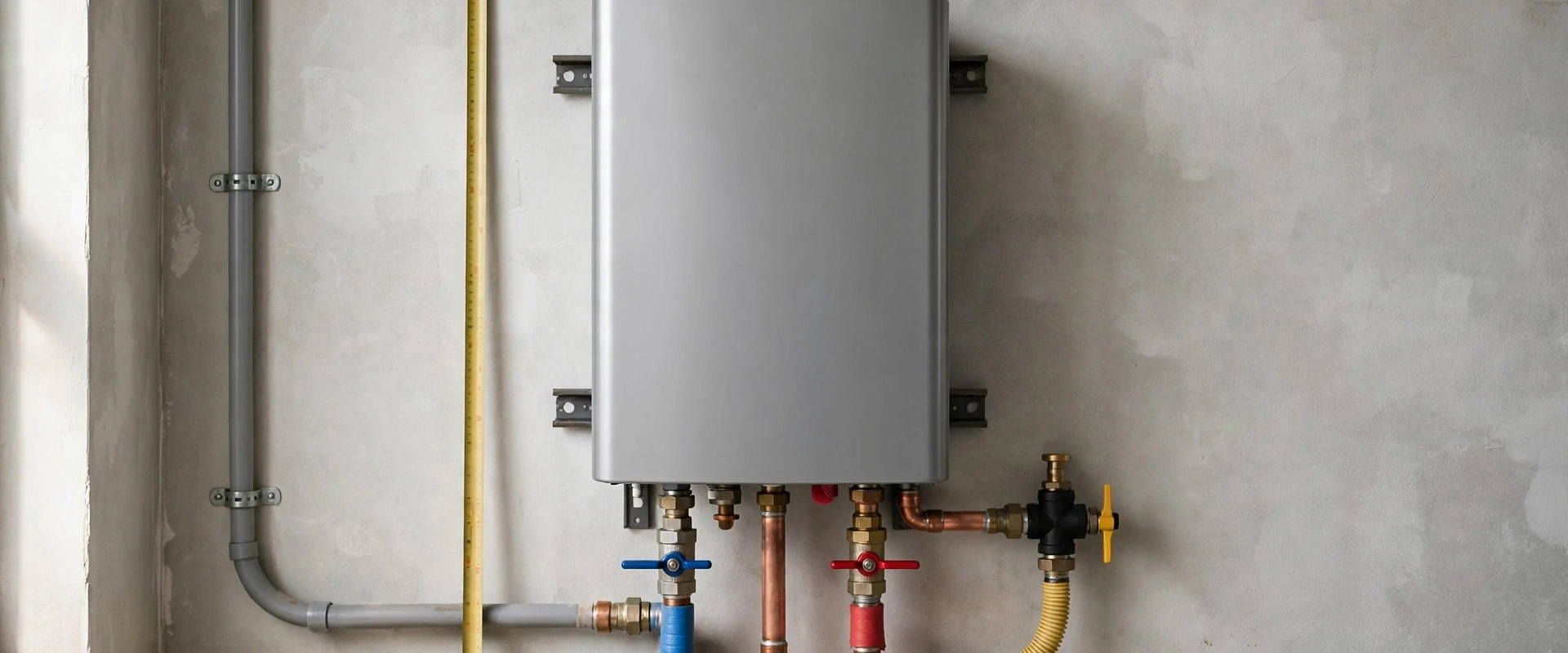
How tankless sizing works
A tank heater stores forty or fifty gallons and the question is whether that supply lasts. A tankless unit stores almost nothing. It heats water as it flows, so the question is how much hot water per minute it can produce, and how much it has to heat that water.
Two numbers decide that. The first is the flow rate, measured in gallons per minute, or GPM, for everything running at the same moment. The second is the temperature rise, which is the difference between the cold water entering the unit and the temperature you want at the tap. A heater that can deliver five GPM at a thirty-degree rise may deliver only three GPM at a seventy-degree rise.
That is why a unit's box lists a maximum GPM, and why the number on the front is only the best case. The useful figure is the GPM at your temperature rise.
The four-step sizing method
List simultaneous fixtures
Write down which hot water fixtures could run at once in a normal busy morning or evening. Think showers, a kitchen tap, a dishwasher and a washer.
Add the flow rates
Use the GPM for each fixture and add them up. That total is the flow the heater must deliver.
Find the temperature rise
Subtract the incoming water temperature from the temperature you set the heater to. Size for the coldest incoming water of the year.
Check the unit's chart
Match the total GPM and temperature rise against the manufacturer's performance chart. Pick a unit that meets or beats that flow at that rise.
Most households size to the realistic peak, not the worst case imaginable. If two showers and a dishwasher regularly overlap, size for that. If a third shower only runs at a holiday, you can live with a short wait now and then.
Typical fixture flow figures
These are general ranges, not exact values, and your fixtures may differ. Check the label on your showerhead and faucets for the real number.
| Fixture | Typical flow in GPM | Notes |
|---|---|---|
| Showerhead | 1.5 to 2.5 | Older or high-flow heads can run higher |
| Bathroom faucet | 0.5 to 1.5 | Often mixed with cold, so less hot water than the full flow |
| Kitchen faucet | 1.5 to 2.2 | Hot draw depends on how far the handle is turned |
| Dishwasher | 1.0 to 2.0 | Draws hot water in bursts during fill cycles |
| Clothes washer | 1.5 to 3.0 | Hot or warm cycles pull the most |
| Tub filler | 4.0 to 8.0 | Large fills can overwhelm a small unit |
Remember that a tap rarely runs hot water only. A shower mixes hot with cold, so the heater delivers less than the shower's full flow. Using the full figure in your count builds in a small cushion, which is useful.
A worked example in round numbers
Picture a household with two showers and a dishwasher. These are illustrations, not a real customer.
Say each shower runs at 2.0 GPM and the dishwasher at 1.5 GPM. If both showers and the dishwasher run together, the total is 5.5 GPM. Suppose the incoming water in winter is about 55 degrees and you want 120 degrees at the fixtures. The temperature rise is 65 degrees.
Now open the manufacturer's chart. A unit rated for a high maximum GPM at a mild rise might deliver only around 4 GPM at 65 degrees. That falls short of 5.5. The household then has choices. Pick a larger unit that holds 5.5 GPM at that rise, accept that the dishwasher and one shower will sometimes compete, or install two smaller units.
If the incoming water is warmer in summer, the same unit gives more flow, which can make it feel like a different heater. Do not size for the summer number.
Gas versus electric limits
Gas tankless units generally deliver higher flow at a larger temperature rise than electric ones. A gas burner puts out far more heat energy than a household electric circuit can supply.
Electric tankless heaters have to draw a large amount of power. A whole-house electric unit may need multiple high-amperage circuits and an electrical panel with room for them. If the panel is full or the service is small, the electrical upgrade can matter more than the heater. Electric units often suit a single bathroom or a point-of-use job, and they are tougher to size for a large family.
Gas units need adequate gas supply too, which brings up the next point.
Gas line and vent upgrades
A tankless gas heater burns fuel at a much higher rate than a tank heater does. The gas line that served a forty-gallon tank may be too small for a tankless unit, especially over a long run. A plumber measures the line length, the pipe diameter and the other appliances on the line, then decides whether the pipe needs to be upsized.
Venting is the other change. Many tankless units are high-efficiency and make condensate, a mildly acidic liquid that needs a drain. They also use different vent materials than a standard draft hood. A plan that ignores venting and the condensate drain is not a complete plan.
These upgrades often affect the price more than the unit itself. They also affect safety, since a leaking gas joint or poor venting is not a small matter. If you smell gas, leave the building and call 911 and the gas utility from a safe distance.
When two tankless units make sense
Two units connected together, or two separate units serving different parts of the house, can solve problems a single unit cannot. A large household with a tub, multiple showers and a laundry room may exceed the flow of one unit. A separate heater at a distant bathroom saves the long wait for hot water. A second unit also gives some backup if one needs service.
The drawbacks are real. Two units mean two gas connections, two vents and more cost. A plumber can compare one large unit with a pair for your layout, and the tankless installation page covers what each setup involves.
Want a straight answer on unit size?
Call the 24/7 line. A licensed plumber can list your fixtures and match a unit, and you hear the price before work starts.
Common sizing mistakes
The most frequent error is sizing by household size alone. Four people can have very different peaks depending on whether showers happen one after another or at once.
Another is ignoring the cold season. The incoming water is coldest in winter, so a unit that is perfect in July can fall short in January. A third is forgetting the temperature rise on the chart. A fourth is buying on the maximum GPM printed in big letters on the box, without checking it at your rise.
Smaller mistakes add up. Leaving the set point higher than needed raises the rise and cuts flow. Skipping a scale check can shorten the life of the heat exchanger. A tankless unit also needs a minimum flow to fire, so a barely open tap may stay cold. When a unit gives lukewarm water after a switch, the plumber can adjust settings or recommend a different size, as the water heater repair page explains.
Sizing a tankless heater in Cibolo: what to know locally
According to the City of Cibolo, the city's water comes mainly from Canyon Regional Water Authority, which supplies Wells Ranch groundwater and Lake Dunlap surface water. The source of the water does not tell you the temperature at your tap, so a measurement is worth more than a guess.
That matters for the temperature rise in your sizing. Do not rely on a generic number. Fill a glass from your cold tap on a winter morning, let it run until the temperature settles, and read it with a kitchen thermometer. Use that reading as your incoming temperature.
The reports we have publish no water hardness figure, so we cannot tell you how fast scale will form in a heat exchanger. Test your tap with a hardness strip and ask your utility for its annual water quality report. Your bill shows whether the City of Cibolo or Green Valley SUD serves you.
We also dispatch for tankless work in nearby Schertz and Selma, where the sizing steps are the same.
Questions about sizing a tankless heater in Cibolo
It depends on how many fixtures overlap. Add the flow of the fixtures you use at once, as in the worked example above. A single bathroom needs far less than a house with two showers running together.
No. An oversized unit costs more up front and may need a larger gas line and vent. The goal is to meet your realistic peak at your coldest incoming temperature.
It does not run out like a tank, but it can run out of capacity. When demand exceeds its flow at your temperature rise, the water gets lukewarm.
Measure your own tap in the cold season. Cibolo water comes from groundwater and surface water, so do not rely on a generic figure.
It depends on your water. Since no hardness figure is published in the reports we have, test your tap first. A plumber can explain options on the water treatment page if the test shows heavy scale.