
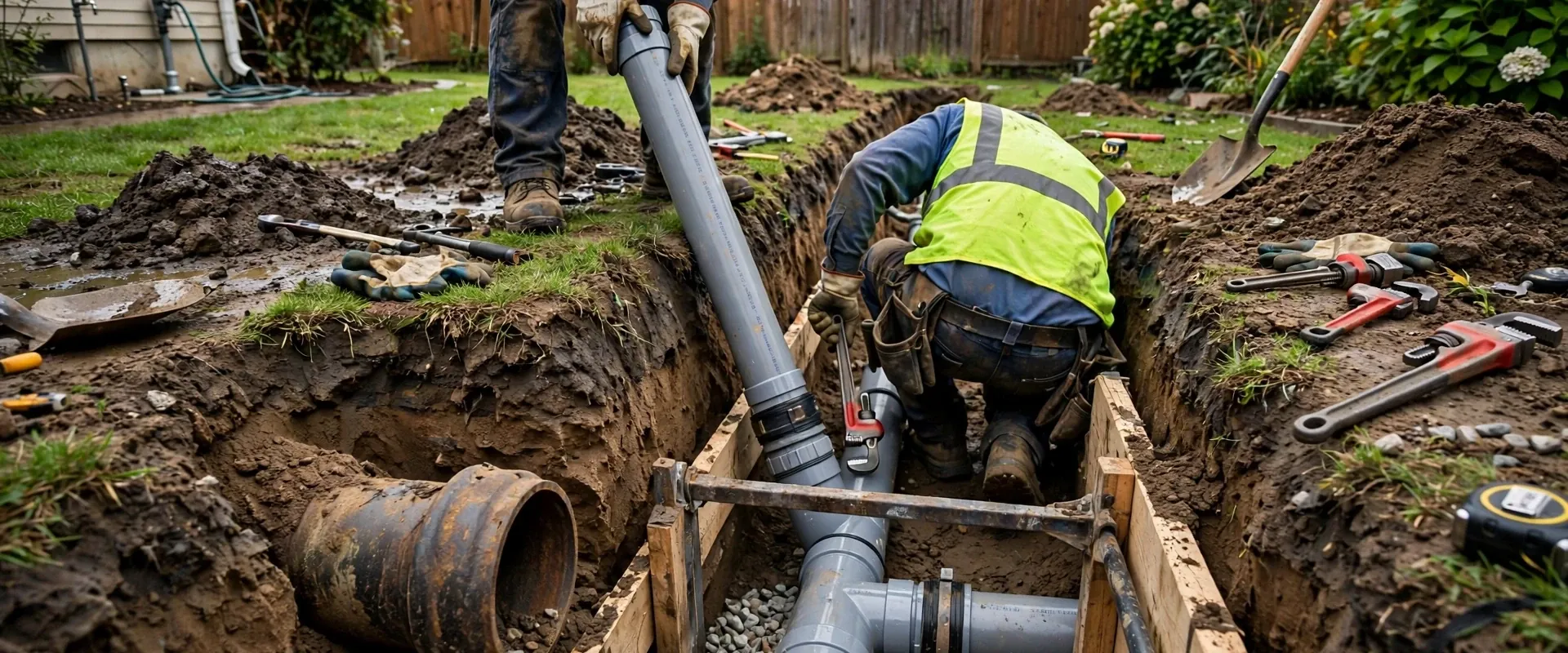
Why sewer line prices vary so much
A sewer line is the buried pipe that carries everything from your drains to the public sewer or a septic system. It runs downhill by gravity, so it cannot be bent around obstacles the way a water supply line can. Whatever is wrong with it has to be fixed at that exact spot, at that exact depth, on that exact slope.
That is why a flat price from a phone description is rarely honest. Two quotes can differ because one plumber assumes a short spot repair and the other has seen the camera footage showing a long, failed run. Until someone looks inside the pipe, any number is a guess.
The sections below walk through what actually changes the price. If you understand these factors, a quote stops being a mystery and becomes a list you can check.
The cost drivers, one by one
Most of the price comes from labor, equipment and the work around the pipe, not from the pipe itself. A length of sewer pipe is cheap. Reaching it, replacing it correctly and putting your yard or floor back is where the money goes.
Depth
Deeper pipe means a bigger excavation, shoring for safety and more soil to move and replace.
Notice that the pipe material and the length are only two of seven items. The rest is about where the pipe sits and what is on top of it. A repair in an open backyard and a repair under a finished garage floor can involve the same pipe and very different bills.
Repair methods and what each one costs you in disruption
Every repair method trades money, mess and lifespan against each other. There is no single best method, only the best one for your pipe and your yard. A plumber who offers only one option may be limited by equipment instead of by what your line needs.
| Method | How it works | Where it fits | Trade-off |
|---|---|---|---|
| Spot dig and replace | Excavate to the damaged section, cut out the bad pipe, install new pipe and backfill | One or two localized defects at a reachable depth | Most disruptive for the dug area, but cheapest in materials and often the most straightforward |
| Trenchless lining | A resin-soaked liner is pulled into the old pipe and cured to form a new pipe inside it | Cracks, root intrusion and joint leaks in a pipe that is still round and in line | Little digging, but the pipe cannot be collapsed or badly offset, and it needs thorough cleaning first |
| Pipe bursting | A cone pulls new pipe through the old one, breaking the old pipe outward as it goes | Long runs of failed pipe where a straight path exists | Needs entry and exit pits, and nearby utilities and structures matter |
| Full replacement | The whole run is dug up and replaced | Severely damaged or incorrectly sloped lines | Highest disruption, but a clean new line from end to end |
Trenchless methods are often described as the gentle option, and sometimes they are. They also depend on the camera showing a pipe that can accept a liner or a burst. A section that has dropped, creating a belly where water pools, may need to be dug and regraded no matter how much you would prefer to avoid it.
You can read more about how repair options are chosen on the sewer line repair page. The key point is that the method is a decision with trade-offs and not a menu item, and you should be told why it was picked.
Why the camera findings set the price
A sewer camera inspection is the step that turns a guess into a quote. A small waterproof camera on a flexible cable travels through the line and records what it sees, including cracks, offset joints, roots, bellies and the point where the pipe is crushed. The plumber can then locate the problem from above ground and tell you how deep it is.
Those findings answer the questions that drive price. How many defects are there? Are they in one place or spread out? Is the pipe still round? Does the slope hold water? Without that, a quote has to include a cushion for unknowns, and a cushion costs you money whether the surprise comes or not.
If a plumber quotes a major repair without looking inside the line, that is a reason to ask for a camera first. A camera inspection of the line also gives you footage you can show a second plumber or your insurer, which makes comparing quotes fair.
Quote looks high or unclear?
Call the 24/7 line. A licensed plumber can inspect the pipe, show you the footage and explain the price before work starts.
How to read a quote
A good sewer quote reads like a plan. It names the section being repaired, the method, the pipe material going in, and what is included for restoration. A vague one-line total is not enough for a job that involves digging up your property.
Before you agree, ask these questions and expect specific answers.
What exactly is being repaired
Ask for the start and end points of the work and how they were found, ideally from the camera.
Which method and why
Ask why that method fits this pipe and what the alternative would be.
What is included in restoration
Ask whether concrete, sod, sprinklers and fences are put back, or only the trench filled.
Who handles permits
Ask who deals with the City if a permit is needed, and ask about having buried lines marked.
Then check the license. Plumbing work is done under a Responsible Master Plumber. The Texas State Board of Plumbing Examiners (TSBPE) has an online license search, and the RMP license number begins with the letter M. A proper estimate or invoice should show that number along with TSBPE contact information, and you can confirm a certificate of insurance is on file.
Repair or cleaning? Signs that point to each
Many sewer problems are not repair problems at all. A blockage from grease, wipes or roots can be cleared with a cable or water jet, and that costs far less than digging. The trick is telling the two apart.
A cleaning is likely if the problem showed up suddenly, the camera shows a clean pipe wall with one plug, and the line flows normally after clearing. A repair is likely if clogs keep coming back in the same spot, the camera shows a crack, a sag or a missing section, or soil and gravel appear in the debris. Clearing roots without fixing the entry point only buys time.
Slow drains throughout the house, gurgling toilets, sewage smell in the yard and a patch of unusually green or soggy lawn above the line are all reasons to get a camera inspection. They do not prove the pipe is broken, but they do prove something is wrong. The fix could be as simple as clearing the sewer line, or it could be a section replaced.
Safety lines for homeowners
Sewer gas and sewage are health hazards, and a deep trench can collapse. If sewage is coming up in a tub or floor drain, stop using water in the house. Do not use chemical drain cleaner on a full blockage, since it can splash back at whoever opens the line.
Do not dig for the line yourself. Buried gas, electric and water lines run through the same yards, and cutting one is dangerous. Ask the plumber or your utility about having buried lines marked before any digging. If you smell gas, leave the building and call 911 and the gas utility from outside.
Insurance and the realities of paying for it
Most homeowners policies cover sudden and accidental damage, such as a pipe that suddenly bursts and floods a room. They usually do not cover wear, age, root growth or slow deterioration, which is the cause of many sewer line failures. Sewer backup coverage is often a separate endorsement.
Some insurers will reimburse the cost of reaching the pipe if a covered leak caused the damage, and others will not. The practical advice is to call your insurer before the work starts, ask what your policy says about sewer lines, and keep the camera footage and the written quote. Do not assume either way, because policies differ.
Sewer repair costs in Cibolo: what to know locally
According to the City of Cibolo, the City no longer bills sewer as of November 2025, and Green Valley Special Utility District (GVSUD) adds the sewer charge. That affects your repair decision because the first question in any backup is who owns the pipe. Ownership decides who pays, so ask the utility.
GVSUD lists an emergency line for suspected sewer clogs at (830) 914-2331. If a neighbor has the same symptoms or a manhole near your home is overflowing, call them before paying for a repair. A plumber with a camera can also show which side of the property line the problem is on.
The City of Cibolo enforces the 2021 International Plumbing Code (IPC), which governs how drains, traps and vents are installed. Permit rules vary, so ask the City of Cibolo building department whether your repair needs one before work begins. A good plumber will know the answer for the job, but you can verify it yourself.
If you live near the edge of Cibolo, the same cost factors apply to neighbors in Schertz and Converse, though permit rules vary.
Common questions about sewer repair cost in Cibolo
Lining and pipe bursting need specialized equipment, a thoroughly cleaned pipe and trained crews. You are paying less for restoration and more for technology. Whether it ends up cheaper depends on how much concrete, landscaping or structure the dig would have disturbed.
Usually yes, because it replaces assumptions with facts. The footage shows how many defects there are and how deep they sit, which lets the plumber price the real job instead of padding for unknowns.
Often not, if the cause is age, wear or roots. Sudden and accidental damage may be covered, and sewer backup frequently needs an endorsement. Call your insurer before work starts and keep your documents.
Repeated clogs in the same spot, a visible crack or sag on camera, or soil in the debris point to a repair. A one-time plug in a clean pipe usually points to cleaning. A camera tells you which one you have.
If neighbors are affected or sewage is rising in the street, call GVSUD at (830) 914-2331. If only your home is affected, call the plumber line and describe which fixtures back up so the right equipment is sent.