
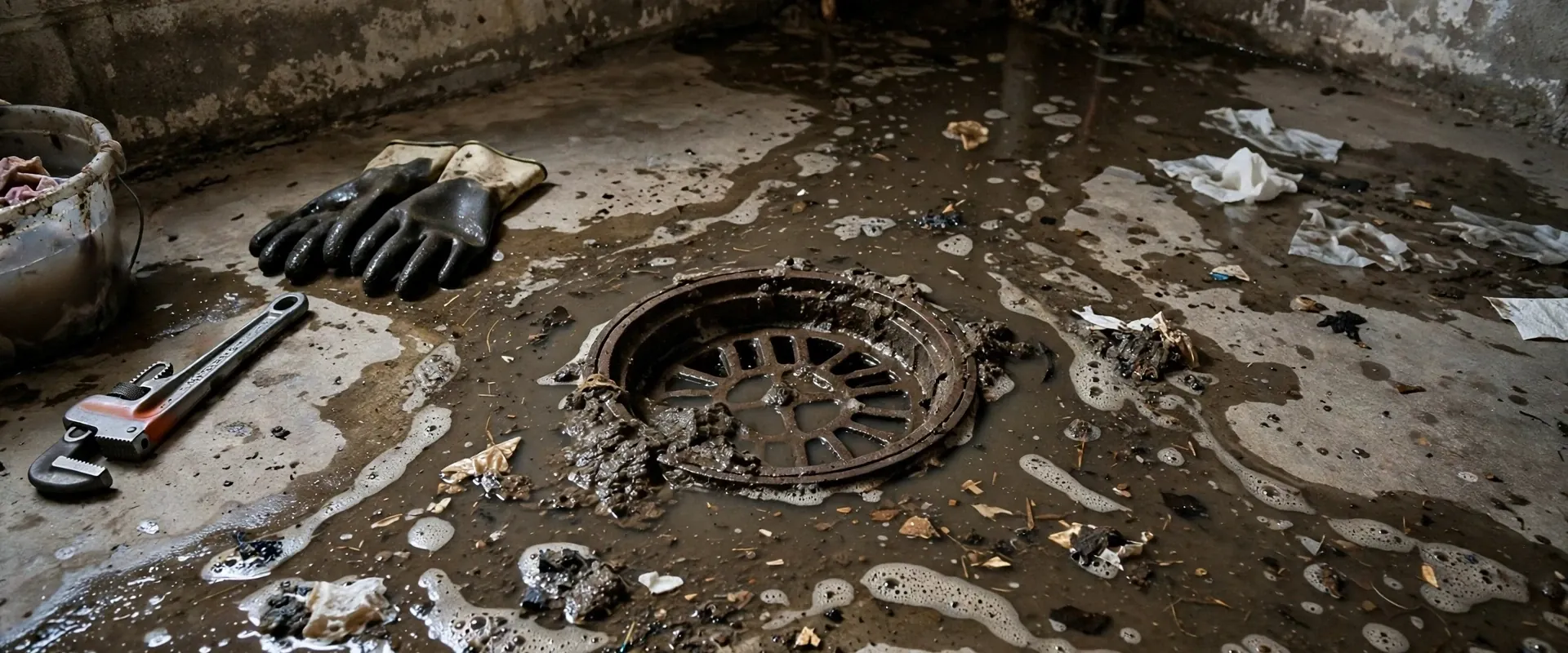
The first steps when sewage backs up
Act in a calm order. Each step either limits the spill, protects people or keeps a record for later.
Stop all water use
Turn off the dishwasher and washer and stop using sinks, showers and tubs. Every gallon you send down adds to the overflow.
Do not flush
Put the lid down on every toilet. A flush sends waste to the lowest opening in the house, which is often a tub, shower or floor drain.
Keep people and pets away
Close doors to the wet room. Children, pets and anyone with a weak immune system should stay out of the area.
Avoid contact
Do not wade through it barefoot. If you must cross the area, wear waterproof boots and gloves, and wash hands thoroughly afterward.
Ventilate if safe
Open windows and run fans only in rooms that are dry and away from the spill.
Photograph everything
Take photos or video of the water line, damaged items and the drains before you move anything. Your insurer will ask.
Do not mix chemicals. Bleach combined with ammonia or an acidic cleaner can release toxic gas, and a bleach pour on top of a drain cleaner can do the same. Skip the bleach for now. Disinfecting comes after the line is open and the water is gone.
Turn off power only to the affected area, and only if the breaker is dry and you can reach it without standing in water. If water is around outlets, a panel or appliances, stay out and let a professional or the electric provider handle it.
Is it your line or the public main?
The answer decides who fixes it and who pays, so work it out as early as you can. The house line, called the building sewer, runs from the house to the point where it joins the public main. The public main runs under the street and serves many homes.
Look for clues. If every drain in the house is slow or backing up, a toilet gurgles when the washer drains, or a lower floor drain or tub is the first place water appears, the main line is involved. That could be your section or the public one.
Ask the neighbors. If the neighbors have the same problem, the blockage is probably in the main. Look for a manhole in the street or easement, and see whether it is overflowing. If it is, do not approach it, and report it to the utility immediately.
| What you notice | What it usually means | Who to call |
|---|---|---|
| One toilet or one sink backs up | Clog in that fixture's branch | A plumber, same-day if possible |
| Several drains back up together, only your home | Blockage in your main building sewer | A plumber, who can cable or jet through the cleanout |
| Neighbors report backups too | Blockage in the public main | The sewer utility first |
| Manhole in the street overflowing | Public main blocked | The sewer utility |
| Backup returns weeks after clearing | Roots, a broken pipe or a belly in the line | A plumber for a camera inspection |
Who to call in Cibolo
Sewer billing in Cibolo changed in November 2025. According to the City of Cibolo, the City no longer bills sewer, and Green Valley Special Utility District (GVSUD) adds the sewer charge. That is why GVSUD is the number to know for a sewer problem in this area.
GVSUD lists an emergency line for suspected sewer clogs at (830) 914-2331. Its main line is (830) 914-2330. Call the emergency number if several homes seem affected, if a manhole is overflowing, or if you are not sure whether the clog is in the street. A utility can check its own main and tell you whether the blockage is on its side.
If the utility finds that its main is clear, or your home is the only one affected, call a plumber. Our 24/7 line sends a licensed plumber to work on the pipes on your side of the property line. A plumber cannot see inside the public main, and the utility handles its own pipes.
What the plumber does to clear a sewage backup
The first job is access. The plumber locates the cleanout, a capped pipe outside or in the garage or basement area that gives a direct path to the main line. If there is no cleanout, access may come from a toilet or a roof vent, which takes longer and is less clean.
Next, the plumber clears the blockage with a cable machine. A drum machine with a heavy cable and a cutting head breaks up a plug or cuts roots. When grease or heavy buildup coats the pipe wall, high pressure water can scour the line, which is the job of hydro jetting. The point of a cable is to open a hole, and the point of a jet is to clean the whole wall.
Then a camera goes in. A video camera on a flexible rod shows the cause, whether that is roots, a sag, a broken joint or a collapsed section. Without a camera, a cleared line is a guess. If the camera finds damage, the next step is repair, described on the sewer line repair page, and you decide with the price in hand.
Honest limits matter. A cable cannot fix a broken pipe, and clearing roots without fixing the break buys time. A plumber cannot see behind a wall or under a slab without opening it, and cleanup of the contaminated space is not plumbing work.
Water still rising or the smell is getting worse?
Call the 24/7 line. A licensed plumber is dispatched for same-day appointments when available, and you hear the price before work starts.
Cleanup and insurance, honestly
After the line is open, the mess remains. Sewage soaks into carpet, drywall, insulation and cabinets, and it carries bacteria. Cleanup and drying belong to a restoration or biohazard cleanup company, which is a separate trade from plumbing. A plumber clears the line and does not clean the house.
Do not rush to throw things out before you have photographed them. Porous items such as carpet pad and drywall touched by sewage are usually removed, and a restoration company knows what must go. Wash hands often, and keep children and pets away until the area is cleaned and dried.
Call your insurer early. Many homeowners policies cover sudden and accidental water damage, but sewer backup coverage often requires an endorsement, a separate add-on. Ask what yours covers before you assume, keep the plumber's invoice and your photos, and ask whether a deductible applies. A utility's responsibility, if its main was at fault, is a separate question to raise with the utility.
What not to do
A few common reactions make things worse. Do not keep running water to see whether it drains. Do not pour chemical drain openers into a backed-up line, because they rarely clear a full blockage and leave dangerous standing water. Do not use a household vacuum on standing sewage, since it can spray contaminated water and wreck the motor.
Do not flush toilets, do not use a plunger over a floor drain full of sewage, and do not step into standing water near electrical outlets. If you smell natural gas, leave the building, call 911 and the gas utility from a safe distance, and do not use switches or phones inside.
Call a licensed plumber right away if sewage is rising, if the smell makes you ill, or if water reaches finished floors. Stay out of the wet area until it is safe. If anyone has symptoms after contact, such as vomiting or fever, call a medical professional.
Sewer backups in Cibolo: what to know locally
According to the City of Cibolo, it stopped billing sewer in November 2025, and GVSUD now adds the sewer charge. For you, the first call for a suspected public sewer clog is the GVSUD emergency line at (830) 914-2331. The main line is (830) 914-2330. Keep both numbers where the whole household can find them.
The City of Cibolo enforces the 2021 International Plumbing Code (IPC), which covers traps, vents and cleanouts for house drains. Permit rules vary, so ask the City of Cibolo building department before work that replaces a section of building sewer. City Hall is at 200 S. Main St., and the general line is 210-658-9900.
Two providers serve Cibolo, the City of Cibolo and GVSUD, and the one that serves you depends on your address. Check your bill for the name before you call, because the utility on the bill is the one to report a street problem to.
We also dispatch to nearby towns, including Universal City and Converse, where the same steps apply.
Common questions about sewage backups
Not yet. Bleach mixed with ammonia or acidic products releases toxic gas, and it will not clear a blockage. Open the line first, then let a restoration company advise on disinfecting.
If every drain in the home backs up and neighbors do too, or a manhole is overflowing, the public main is likely blocked. If only your home is affected, a plumber can use a camera and the cleanout. If you are unsure, call the GVSUD emergency line first.
Often only with a sewer backup endorsement. Many policies cover sudden and accidental damage but not wear or a blockage from buildup. Ask your insurer, photograph everything, and keep the invoice.
Yes. The line is answered around the clock, and a licensed plumber is dispatched for same-day appointments when available. We do not promise an arrival time, and you hear the price before work starts.
According to the City, GVSUD adds the sewer charge. If your bill is unclear, check the utility name on it or call the City at 210-658-9900. For a backup, the GVSUD emergency line is (830) 914-2331.