
Why scale builds up inside a tankless heater
Water carries dissolved minerals, mostly calcium and magnesium. When the water is heated, those minerals come out of solution and form a hard deposit called scale. The effect is stronger the hotter the surface is and the more mineral content there is in the water.
A tankless heater makes this worse than a tank in one way. The heat exchanger is a narrow set of passages, and the burner or element heats the metal to a high temperature while water flows through quickly. A thin layer of scale barely matters in a tank, but in tight passages it restricts flow and insulates the metal from the water. The unit then works harder, overheats more easily and wastes gas or electricity.
Scale does not announce itself. It builds a little with every cycle, so the loss in performance is slow. Many owners find out only when a code appears or the shower turns lukewarm.
Signs your tankless heater needs a flush
Watch for a list of small changes rather than one big one. Common signs are an error code on the display and weaker hot water flow. Others are rumbling or popping noises, a longer wait for hot water, and temperature that swings at the same tap.
Some units also show a scale or maintenance reminder. Your manual lists the exact codes, and those differ by brand. Look up the code before you assume it is scale, because a code can also point to a sensor, a vent, a gas supply or a flow problem that a flush will not touch.
If the signs match and the manual calls for flushing, the job is well within reach for a careful homeowner. It is a maintenance task, not a repair, and the manufacturer's instructions for your model come first.
What you need before you start
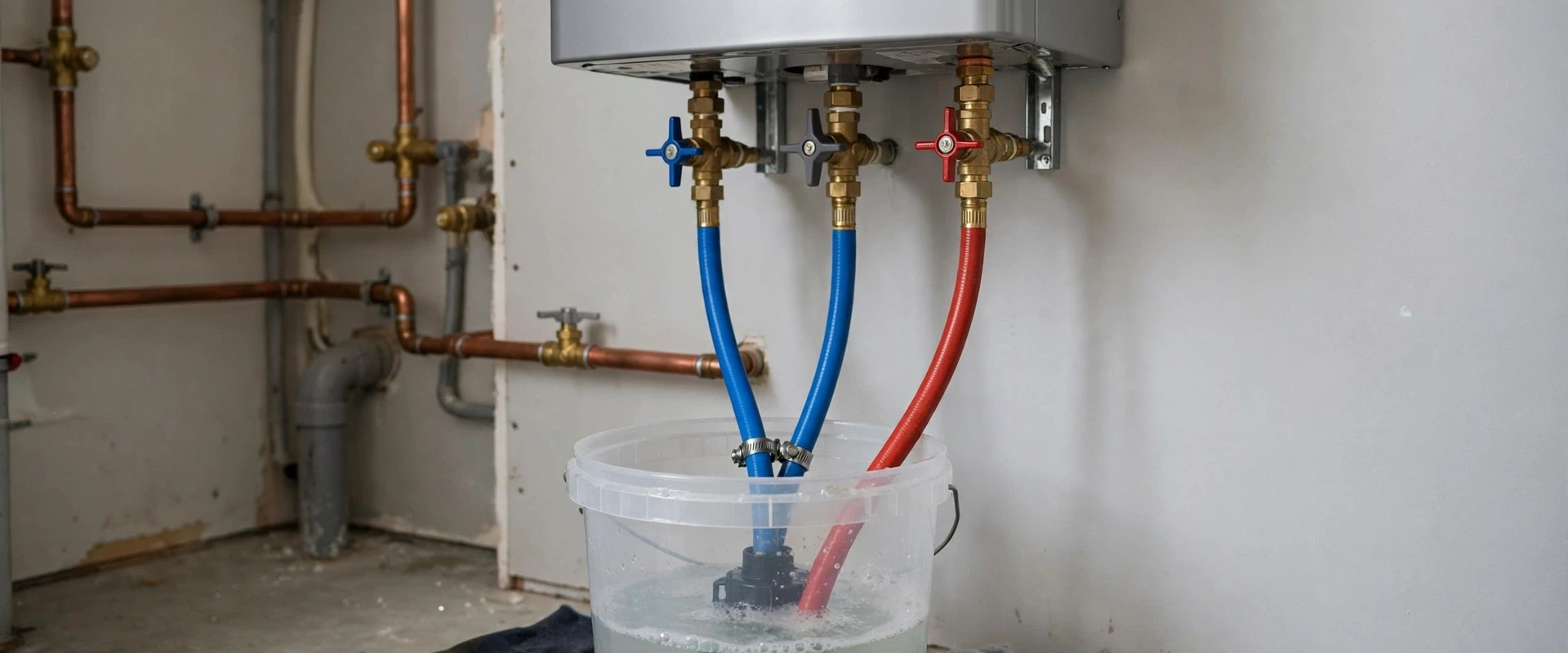
You need a small submersible utility pump, two washing machine style hoses, a five gallon bucket, and descaling solution. Many manufacturers specify a product or white vinegar. Follow your manual, because the strength and the type matter, and some products are not suitable for some parts.
You also need isolation valves. Tankless units are often installed with a service valve kit, a set of three way valves with hose ports on the hot, cold and relief side. These let you close the building's water and open a path for the pump. Without them, the flush is much harder and often involves cutting into pipe.
Gather a flashlight, a towel, an adjustable wrench and a pair of gloves. Have a spare filter screen gasket if your manual lists one. Set the bucket on the floor beside the unit so the hoses are short and gentle.
The flush, step by step
Power and gas off
Switch off the electrical supply and close the gas valve to the unit. Let the unit cool, because the water inside can be hot.
Close the water valves
Shut the cold water isolation valve and the hot water valve on the service kit. Open a hot tap elsewhere to relieve pressure.
Connect the hoses
Attach one hose from the pump to the cold service port and the second from the hot port back into the bucket. Pour in the descaling solution.
Open the ports and circulate
Open the service ports, run the pump for the circulation time stated in your manual, and watch the bucket liquid for debris.
Flush with clean water
Disconnect the pump, close the ports, open the cold supply for a few minutes and run clean water through to drain the solution.
Clean the inlet screen
Remove the cold water filter screen, rinse off sediment, and reinstall it with its gasket seated.
Reassemble and restore
Close the ports and open all valves. Restore power and gas, then check every connection for leaks.
Do the steps in order, and read your own manual for the circulation time and the solution. Some models call for a particular valve position, and getting one valve wrong can send solution into your plumbing or leave a port open.
After you restore power, run a hot tap and listen to the unit start. Look at each connection for beads of water, and look again after the unit has run through a full cycle. A weeping port is common after a flush because a washer was not seated.
If the unit lights and heats normally, you are done. If it shows an error code, shut it down and check the manual before trying again.
Not sure your unit has service valves, or the flush will not come clean?
Call the 24/7 line. A licensed plumber can service the unit, and you hear the price before work starts.
How often to flush
There is no single schedule. The right interval depends on how much mineral is in your water and what the manufacturer's manual says. A common range in manufacturer guidance is about once a year, but a household with a lot of dissolved mineral may need it more often, and one with a softener may need it less.
Cibolo does not have a published hardness figure in the reports we have reviewed, so test your tap rather than guess. Inexpensive test strips from a hardware store give a rough reading, and your water utility can tell you what its annual water quality report covers. Use your own result and the manual to set the schedule.
A simple habit helps. Write the flush date on a tag near the unit, and check the inlet screen each time you flush. If the screen is full of grit, the unit is catching more sediment than you thought, and a shorter interval makes sense. A whole-house softener or filter is another option, as described under water softener and filtration.
| Situation | What it usually means | Best next move |
|---|---|---|
| Slow drop in flow and a rumbling sound | Scale on the heat exchanger | Flush using the manual's steps |
| Error code that clears after a flush | Scale was the cause | Set a regular flush schedule |
| Error code that returns after a flush | Another fault, such as a sensor or vent | Call a licensed plumber |
| No service valves on the unit | Flush is harder and may need new fittings | Call a plumber to add valves |
| Gas smell near the unit | Gas leak risk | Leave the building and call 911 and the gas utility |
| Water leaking from the unit body | Failed part or cracked exchanger | Shut off water and power, then call |
When to stop and call a licensed plumber
Do not try to flush if the unit has no service valves and you are not comfortable cutting into the lines. Adding valves means working with pressurized supply pipes and, often, gas, and a mistake can cause a flood. A plumber adds the valves, and they make every future flush a short job.
Gas appliances call for caution. If you smell gas at any point, leave the building and call 911 and the gas utility from a safe distance. Do not use switches, phones or flames inside. Do not attempt to adjust a gas valve, vent or burner on your own, because those parts affect combustion and safety.
Call as well if the unit leaks from its body, if the same code returns after a flush, or if the water stays cool. A repeated fault can mean a failed part, and a worn unit may not be worth another repair. A plumber can explain that choice, and you hear the price before any work. Details on tankless service are under tankless water heaters.
Flushing a tankless heater in Cibolo: what to know locally
According to the City of Cibolo, the City buys nearly all of its water from Canyon Regional Water Authority (CRWA). That supply is Wells Ranch groundwater from the Carrizo-Wilcox aquifers plus Lake Dunlap surface water. That mix is the City's stated supply, so the mineral content you see at your tap depends on the sources feeding your address.
Two providers serve Cibolo. The City of Cibolo and Green Valley Special Utility District (GVSUD) each serve different addresses, and GVSUD also has its own wells in Comal County. Check which name is on your bill and ask that utility for its annual water quality report. The 2025 reports we have reviewed give no hardness figure, so do not assume your water is hard or soft. Test your tap and use the result to set your flush schedule.
The City enforces the 2021 International Plumbing Code (IPC). Relief valves on water heaters need a discharge line. Permit rules vary, so ask the City of Cibolo building department before work like adding valves or moving a unit.
We also dispatch to Schertz and Selma, where a plumber can service tankless units in the same way.
What happens after the flush
Leave the unit running normally and note how it feels. Flow should be steadier, the unit should be quieter and the wait for hot water should be about what it was when new. If not, scale may be only part of the story.
Descaling does not repair a worn heat exchanger. Scale that has been left to build for years can eat away at the metal, and a unit with a cracked exchanger leaks and must be replaced. A plumber can tell you whether a unit that still struggles can be fixed or is near the end of its life.
As a general rule, tankless heaters often outlast tank models when maintained. That depends on the water, the brand and the care they get.
Keep the receipts and the date for the warranty. Some manufacturers ask for proof of maintenance if you file a claim, so a log of flush dates is worth keeping. Ask your insurer if you are unsure how a failed heater would be handled, because most homeowners policies cover sudden water damage and not wear.
Common questions about flushing a tankless heater
Many manuals allow white vinegar, and some name a specific descaling product. Follow your manual for the type, strength and circulation time. Using the wrong solution can harm seals and parts.
Look at the pipes below the unit. A service valve kit has two or three way valves with small capped ports on the hot and cold lines. If you see only plain shutoff valves, the kit is missing, and a plumber can add one. If the unit has a fault beyond scale, see repair options for the heater.
It depends on your water and the manual. No hardness figure is published in the reports we reviewed, so test your tap, then use the manufacturer's interval. Ask your water utility for its annual water quality report.
Flushing the water side is a maintenance task, but you must turn off the gas and power first. If you smell gas, leave the building, call 911 and the gas utility from a safe distance. Do not adjust gas parts yourself.
Check your bill, because the two providers serve different addresses. Both use chlorine in their systems, and the 2025 reports list averages of 2.26 ppm and 1.70 ppm for the City and 1.68 ppm for GVSUD, though none of the reports we reviewed give a hardness figure. The flush interval still comes from your manual and your own tap test.