
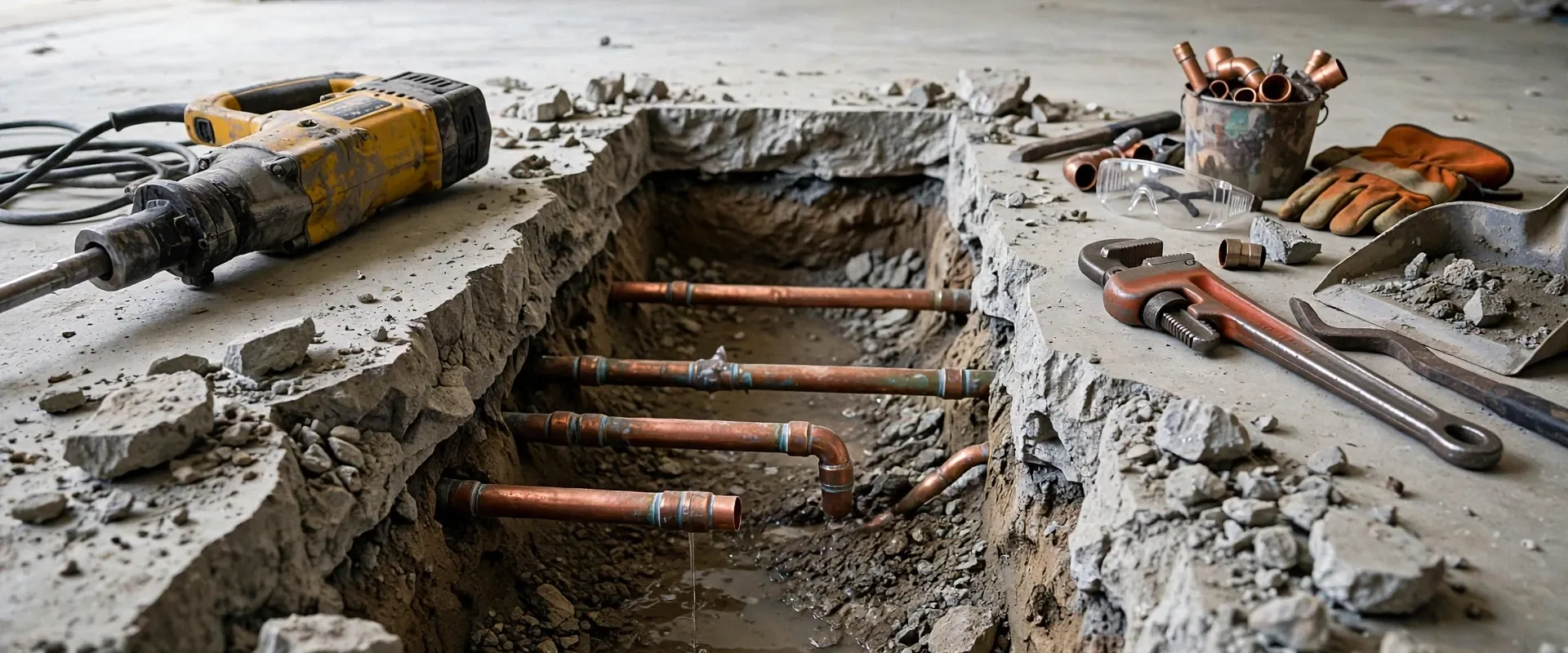
Why hot lines leak under the slab more often
This applies only if your home is built on a concrete slab foundation. Not every house is. If yours has a crawl space or basement, the supply lines are in reach and the picture is different.
On a slab, supply pipes are often embedded in or run beneath the concrete. Hot lines work harder than cold ones. Every time the water heats, the pipe expands, and every time it cools, it contracts. That movement rubs the pipe against concrete, sand or fittings and wears at pinholes, especially at elbows and joints. Hot water also speeds up chemical corrosion from the inside.
None of that makes a slab leak certain. Many homes on slabs never have one. It simply explains why, when one does happen, the hot side is more often the culprit, and why you may hear it described as a "hot slab leak."
Signs of a hot water slab leak
The clues usually appear in this order. First a bill that creeps up, then something you can feel or hear. Here is what to watch for.
Warm spot on the floor
A patch of tile, wood or carpet that is warmer than the floor around it, especially in one place.
Hot water running when nothing is on
You hear a faint hiss or rushing in a quiet house, or the hot tap takes a long time to run warm.
Heater cycling often
A gas heater firing or an electric element switching on without anyone using hot water means the tank is replacing lost heat.
Higher bills
Water and gas or electric bills rise without any change in how you live.
Wet or damaged flooring
Lifting laminate, a bubbling base or damp spot at a wall base can follow a leak nearby.
Those signs also match other problems, such as a leaking tank or a toilet that keeps refilling. A plumber can rule those out first, which is why finding the leak comes before pricing a repair. Our electronic leak detection page explains how the pipe is traced without opening the floor.
What drives the cost of a hot slab leak repair
No honest number can be quoted before the leak is located. The price is built from a few parts, and each can swing the total.
Locating the leak
Acoustic listening, pressure testing and sometimes thermal imaging take time. A leak under a long run of pipe takes more of it than one near a wall.
Timing matters too, because a leak that runs for weeks wets the subfloor and can lift flooring, so the restoration side grows the longer the water runs. You get a clear price before work starts, and any change once the plumber sees the pipe is explained before anything else is done.
Repair methods and the trade-offs
Each approach fits a different situation.
A spot repair means opening the slab above the leak, cutting out the damaged pipe and splicing in a new section. It is the most direct fix when one section has failed and the rest of the pipe is sound. It leaves a patched square in the floor and does nothing for other weak spots in the same line.
A reroute abandons the buried line and runs a new one through walls or the attic. It avoids breaking the slab, but it needs access to wall cavities, and it may mean cutting drywall at several points. It often suits a line with repeated leaks, because the new pipe is outside the concrete where it can be reached later.
Lining coats the inside of a pipe with a resin to seal pinholes. It suits some pipe layouts and conditions, and it cannot fix a pipe that is crushed or badly separated. A plumber can tell whether your line is a candidate only after inspecting it, and not every plumber offers it.
None of these is best for all homes. The right pick depends on pipe condition, leak count, access and how much disruption you accept. The page on repairing a leak under the foundation walks through the same options in more detail.
| Situation | What it usually means | Common approach |
|---|---|---|
| One leak, rest of the line sound | A single failed fitting or pinhole | Spot break-in and splice |
| Repeated leaks in the same hot line | Pipe is wearing out along its length | Reroute or replace the line |
| Leak under finished flooring or cabinets | Access is costly and disruptive | Reroute through walls or attic |
| Pipe layout suits it and pipe is intact | Pinholes without structural damage | Lining, if offered |
| Leak at a slab edge or wall base | Short run to reach | Smaller spot repair |
How to compare quotes
Two quotes for a slab leak can differ widely for reasons that have nothing to do with fairness. Ask each plumber the same questions so you can compare the work, not just the total.
First, ask how the leak was located and whether the quote assumes only one leak. Second, ask which method is proposed and what happens if more leaks turn up.
Third, ask who handles the flooring, drywall and paint, because some quotes include restoration and others stop at the plumbing. Fourth, ask whether a pressure test follows the repair. Fifth, check the plumber's license on the TSBPE license search and ask for the Responsible Master Plumber number on the written estimate.
A very low number that skips locating the leak or leaves out restoration is not a bargain. A quote that cannot explain its assumptions is a warning sign too.
Not sure if it is a slab leak?
Call the 24/7 line. A licensed plumber can check, and you hear the price before work starts.
Insurance and slab leaks
Most homeowners policies cover sudden and accidental damage, but wear and corrosion are usually treated as maintenance. The wording on slab leaks varies a lot. Some policies pay for the cost of locating the leak and the tear-out and repair needed to reach it, even if they exclude the pipe itself. Others cover only the resulting water damage. Many treat the leak location and the access work differently from the repair, so the answer can be split.
Ask your insurer before work begins, and ask what documentation they want, such as photos, the plumber's written findings and meter readings. Do not delay emergency steps while you wait, because water left running adds to the damage.
Safety and what to do while you wait
If you suspect a leak under the slab, shut off the water heater supply and see whether the sound stops. If it does, the leak is on the hot side. Close the main water valve if water is pooling or spreading, and keep people away from wet floors near outlets or appliances.
If you smell gas, leave the building and call 911 and the gas utility from a safe distance. Do not try to find the source yourself. Never run a gas appliance in a house where you suspect gas is escaping.
Call a licensed plumber promptly if the floor is warm and wet at the same time. Hot water under pressure can scald, and wet slab edges can loosen flooring and moisture can reach the walls.
Cibolo slab leak billing and leak adjustment: what to know locally
City of Cibolo customers can watch a leak signal in My Water Advisor. According to the City, a drop icon appears when the meter has not idled for 3 consecutive hours within a 24 hour period. A hot slab leak runs steadily, so that icon is a strong hint that water is escaping around the clock. Use it along with the signs above, then call a plumber to confirm.
After the repair, the City's leak adjustment may reduce part of the bill. Per the City, it works as a discount on the consumption charge and does not forgive the whole amount. Usage must return to normal, which can take up to two billing cycles. Send the Leak Adjustment Form and your repair receipts to City Hall at 200 S. Main St. Keep the plumber's written invoice, because it is the proof the City will ask for.
If your bill comes from Green Valley SUD, your account has its own policies, so call them. We also help homes on slabs in Schertz and Universal City, where the same cost factors apply.
Questions about hot water slab leaks in Cibolo
Shut off the cold supply to the heater and watch the meter, or check whether a hot tap takes unusually long to warm. A plumber can confirm with listening gear and a pressure test, since both lines can leak at once.
Sometimes. A reroute through walls or the attic avoids the slab, and lining may work on some lines. A spot repair opens the concrete. The plumber explains which fits your home.
It depends on the policy. Some pay for locating the leak and access, others only the water damage. Ask your insurer before work starts and keep photos and the written findings.
Because the first quote assumes a certain location and depth. Once the plumber sees the pipe, the count of leaks and the access path may differ. You hear about any change before extra work is done.
The City enforces the 2021 International Plumbing Code (IPC). Permit rules vary, so ask the City of Cibolo building department whether your repair needs one.