
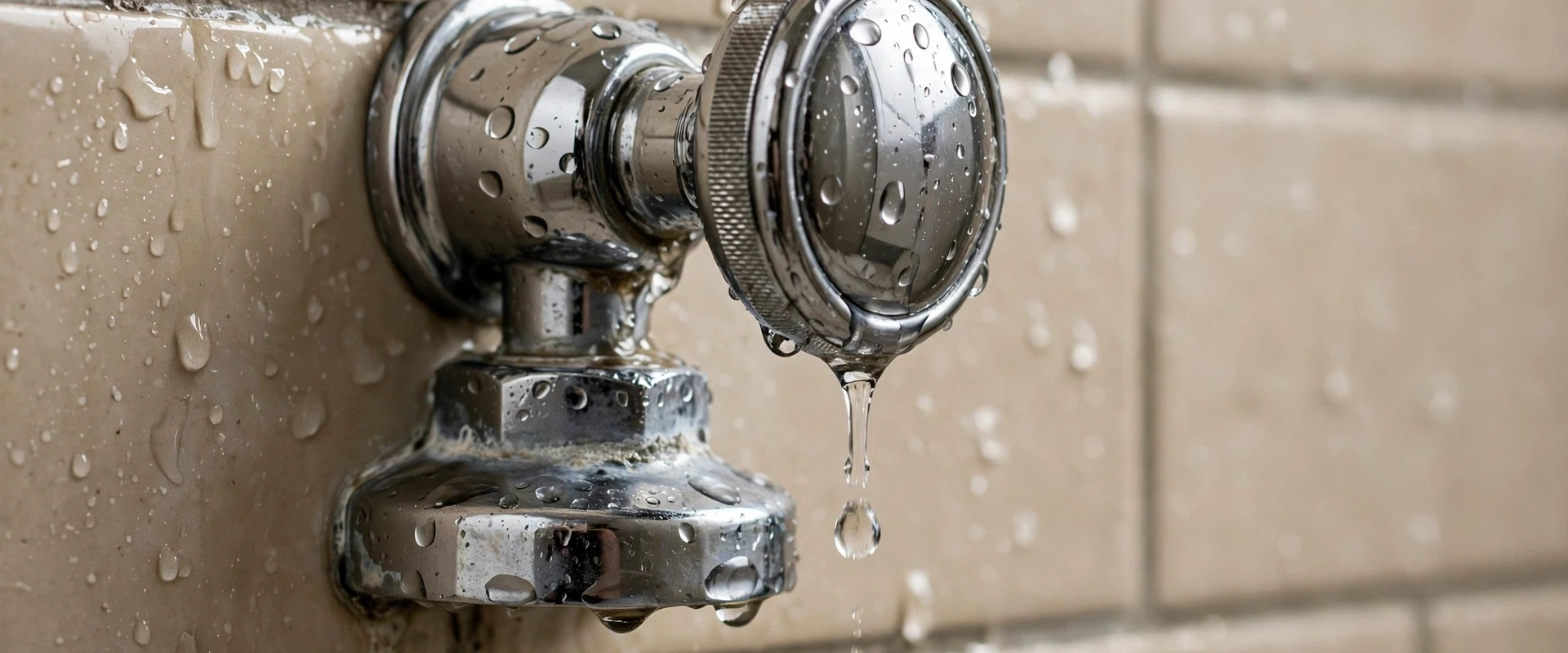
Start by reading the drip
Where the water appears tells you what failed. Spend a few minutes watching before you buy anything.
Water dripping from the showerhead after you shut the handle means the valve is not sealing.
A tub spout that runs or drips points to the same cause, or to a worn diverter if water also comes out of the showerhead when you want the spout only. Water leaking around the handle or trim plate suggests a worn stem seal or a loose cartridge retainer.
Hot water that drips but cold does not points to a failing hot-side seat, stem or cartridge port.
One more clue matters. If the drip stops when you turn the handle to a slightly different position, the cartridge or stem is probably worn or its seals are scored. If it never stops, no matter how you set the handle, the valve may be partly broken.
| What you see | Likely cause | What to try |
|---|---|---|
| Showerhead drips after shutoff | Worn cartridge, stem or seat | Replace the cartridge or the stem and seat |
| Tub spout drips | Same valve wear, or a worn diverter | Replace valve parts, check the diverter |
| Water leaks from the handle | Worn O-ring, loose retainer | Replace seals, tighten the retainer |
| Only the hot side drips | Failing hot stem or port | Replace that stem or the whole cartridge |
| Water is scalding or runs cold | Worn pressure-balancing spool | Replace the pressure-balancing cartridge |
| Wet wall or ceiling below | Supply or valve body leak | Stop DIY and call a plumber |
Know your valve type
Showers use a few kinds of valves, and the repair depends on which one you have. Looking at the handle and trim tells you most of what you need to know.
A single-handle cartridge valve has one lever that you push and pull for volume and turn for temperature. A cartridge inside the wall controls both.
A two-handle valve has a hot handle and a cold handle. Each one has either a compression stem with a rubber washer or a quarter-turn cartridge.
A pressure-balancing valve is a single-handle design that keeps the temperature steady when someone flushes a toilet or runs a tap elsewhere. A thermostatic valve does the same job with a temperature-sensing element and often has two controls, one for volume and one for temperature.
These designs are similar enough that the steps below fit most of them. The big difference is the replacement part, which is specific to the brand and model of the valve. Look for the brand name on the trim, or remove the handle and read the stamping on the cartridge.
Shut off the water first
Before you take anything apart, stop the water. Some showers have small stop valves, called fixture stops, on the supply lines near the valve, often reached through an access panel on the other side of the wall or in a nearby closet. If you have them, turn them clockwise to close.
Most homes do not have shower stops. In that case, close the main water valve for the house. Open a tap on the lowest floor afterward to drain the line. Then open the shower to confirm the water has stopped. If the main valve will not close or leaks when you turn it, stop and call a plumber, since forcing an old valve can break it.
Keep the drain covered with a rag or stopper. Small screws and clips vanish down a shower drain faster than you expect.
Reaching the valve
Most shower valves are accessed from the front, through the trim. Peel off the decorative cap or loosen the set screw on the handle, then remove the handle and the trim plate, called the escutcheon. This exposes the valve stem or the end of the cartridge.
Some designs also have a stop or a sleeve that must come off first. A retaining clip or nut holds the cartridge in place. Take a photo before removing anything so you can reassemble in the right order.
Other showers have no front access at all. In that case, the valve may be reached from the back of the wall, through an access panel in a closet, utility room or next room. If there is no panel, the repair means cutting into the wall, and that is where many homeowners should stop. An opening in tile or fiberglass is hard to make cleanly and harder to repair.
Replacing the cartridge or stem
With the water off and the valve exposed, pull out the retaining clip or unscrew the nut. Grip the cartridge stem with pliers and pull straight out, rocking it gently if it resists. Some cartridges are stuck with mineral deposits and need a puller made for that brand, which the manufacturer or a hardware store may sell.
For a compression stem, unscrew the stem with a wrench, then look at the rubber washer on the end and the brass seat inside the valve body. A flattened or cracked washer is the usual culprit. A rough, pitted seat means the washer will not seal even when new, and the seat must be resurfaced or replaced with a seat wrench.
Match the part
Take the old cartridge or stem to the supplier and match it by shape, length and number of splines, since lookalikes often fail to fit.
Clean the valve body
Wipe out grit and mineral flakes with a rag and rinse so the new seals sit cleanly.
Grease the seals
Apply plumber's grease to new O-rings, then slide the cartridge in with the correct orientation, matching the notch or tab to the slot.
Reassemble and test
Replace the retainer, trim and handle, then restore the water slowly and check for drips at the trim and at the spout.
Tighten the retainer snugly but not hard. Over-tightening can crack plastic bodies or squeeze the seals so tightly that the handle binds. Run the shower for a few minutes and check the wall around the trim for any dampness.
The tub spout diverter
If water drips from the tub spout, or flows from the spout and the showerhead at the same time, the diverter is often the problem. Many spouts have a small pull-up knob that sends water up to the showerhead. When the internal seal wears, water leaks down the spout even with the diverter lifted.
A slip-on spout can be loosened by turning a small set screw underneath.
A threaded spout is unscrewed by turning counterclockwise, ideally with a rag around it to protect the finish. A spout that has been on for many years may be stuck, so go slowly. Replacement spouts are sold by pipe size and style, and the swap is usually simple. If a spout is leaking from the wall behind it, that is a sign of a supply or a joint problem, and a plumber should look at it.
Common mistakes
A few errors turn a small repair into a big one. Replacing the wrong cartridge because it looked similar is the most common. Over-tightening the retaining nut is next, followed by forcing a stuck cartridge with a pry bar and cracking the valve body. Another is forgetting to close the drain, which loses small parts. A fourth is turning the water back on fast, which pushes grit into the new seals.
Also avoid caulking or sealing a leaking trim plate to hide a leak. Water behind the wall rots framing and grows mold, and caulk only hides it. If water is escaping behind the trim, find out why before you seal anything.
Not sure which part failed?
Call the 24/7 line. A licensed plumber can diagnose the valve and give you the price before work starts.
When to stop and call a licensed plumber
Put the tools down if there is no access panel and the repair means opening tile or fiberglass. Stop if the cartridge will not come out after a reasonable try, if the valve body is cracked, or if corroded supply fittings are visible. The same goes for a main valve that will not close. A plumber doing shower valve repair can replace the whole valve body when the old one is beyond saving.
Call right away if you see a wet spot or stain on a ceiling or wall near the shower, if the floor under a tub feels soft, or if the water bill climbs while the fixtures are off. A hidden leak behind the valve is a job for leak detection, which uses listening equipment and moisture checks to find where water is escaping before walls are opened. You can read how that process works on the leak detection page.
If the shower will not turn off, close the main water valve for the house and call. Do not wait for it to run.
Shower leaks and your main shutoff in Cibolo
Cibolo is served by two water providers, the City of Cibolo and Green Valley SUD, and your bill names the one that serves your address. Mineral crust on the showerhead is common, but the reports we have from both utilities list no hardness figure. Ask your water utility for its annual water quality report, and test your own tap before deciding the water is the cause.
Know where your main shutoff is before you need it. According to the City of Cibolo, in February 2021 it issued a boil water notice for its Upper Pressure Zone after distribution pressure dropped, as required by TCEQ. Green Valley SUD customers were told to contact GVSUD.
Events like that are a reminder that pressure changes happen, and that a homeowner who can find the main valve in seconds is better prepared for a burst fitting or a stuck shower valve.
Test the main valve once a year by closing it and opening it. If it is stiff or leaks at the stem, have a plumber replace it while the house is calm. The City of Cibolo enforces the 2021 International Plumbing Code (IPC), and permit rules vary, so ask the City of Cibolo building department before replacing the valve itself or opening a wall.
The same shower repair steps apply to neighbors in Selma and Converse.
Common questions about leaky shower faucets in Cibolo
Hot water expands the parts inside the valve, and a worn seal or cartridge may only leak when warm. It still points to wear, so replace the cartridge rather than waiting for the leak to grow.
If you have fixture stops near the valve, those are enough. Most showers do not have them, so the main valve is the usual choice. Open a low tap afterward to drain the line.
Often yes. Many cartridges and stems are reached through the trim, with no cutting. If your valve needs an access panel and none exists, a plumber can tell you whether the wall must be opened.
The location varies, so look near the water meter outside or where the line enters the house, and inside near the water heater. Find it now and label it for everyone in the household.
Usually not, but it should be fixed. A shower that will not shut off, or water showing on a wall or ceiling, calls for the main valve to be closed and a plumber to be called.