
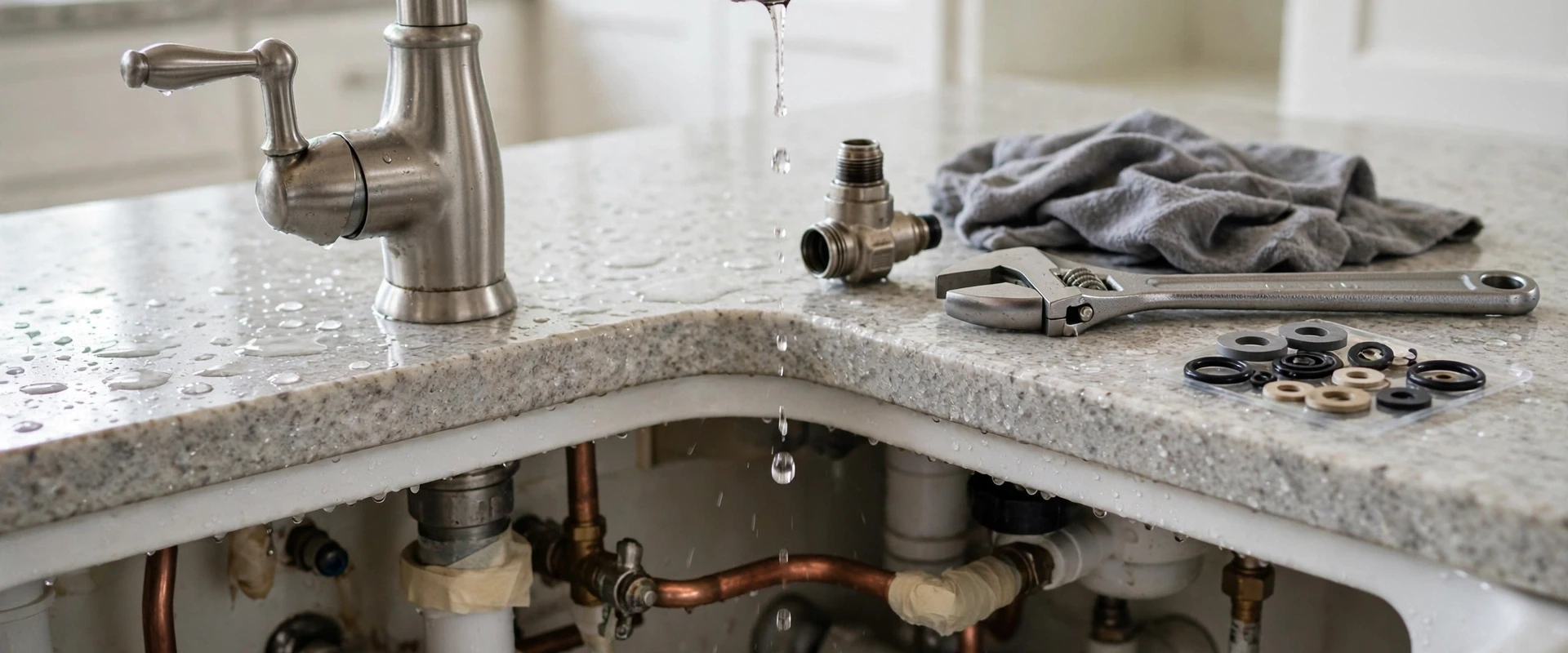
Where is the drip coming from?
Before you buy parts, watch the faucet for a few minutes. The location of the leak tells you which part is worn, and it saves you from replacing the wrong one.
A drip from the tip of the spout means the valve inside is not sealing when it closes. In a compression faucet that is a worn washer or a pitted seat. In a cartridge faucet, it is a worn cartridge or damaged seals.
Water that seeps out around the base of the spout points to worn O-rings where the spout swivels. Water that leaks around the handle points to a loose packing nut, a worn stem seal or a cracked cartridge body.
A leak that only shows up when the sprayer is used often points to the diverter or the sprayer hose, not the main valve. And water that appears in the cabinet below is a separate problem. It may be a supply line, a shutoff valve or the faucet itself, so check it carefully before assuming anything.
| Where it leaks | What is usually worn | What you replace |
|---|---|---|
| Drips from the spout when off | Washer and seat, or cartridge | Washer, seat or whole cartridge |
| Leaks at the spout base | O-rings on the swivel | O-ring set for that model |
| Leaks around the handle | Stem seal, packing or cartridge | Cartridge, O-rings or packing |
| Handle is stiff or gritty | Mineral buildup or worn cartridge | Cleaned or new cartridge |
| Water under the sink only when the tap runs | Supply line, shutoff or hose | Supply line or shutoff valve |
Tools and parts to gather first
You do not need a large kit. Most kitchen faucet repairs use a small set of tools and one replacement part.
- Adjustable wrench and a set of screwdrivers, flathead and Phillips
- Hex keys, since many handles hide a small set screw
- Needle-nose pliers for pulling out clips and old cartridges
- Plumber's grease for new O-rings and seals
- A rag, a small bowl and a towel to protect the sink
- White vinegar and an old toothbrush to clean mineral deposits
Identify the faucet before buying a cartridge. Brand and model are often stamped on the underside of the body or printed on the box if you kept it. If you cannot find them, take the old cartridge or washer to the hardware store and match it by hand. Cartridges from different brands look alike but do not interchange, so a close match is not good enough.
Step by step: replacing a cartridge or washer
The sequence below fits the two most common designs. A compression faucet has two handles that you screw down to close. A cartridge faucet has one lever or two handles that turn a sealed insert. The steps share the same first half.
Shut off the water
Close the two shutoff valves under the sink by turning them clockwise. Open the faucet to release pressure and confirm the flow stops.
Plug the drain
Place a rag or stopper in the sink drain so a dropped screw or clip does not disappear.
Remove the handle
Pry off the decorative cap, remove the screw underneath, then lift the handle off. Some have a set screw on the side.
Take out the old part
Unscrew the retaining nut or clip. Pull the cartridge straight up, or remove the stem and washer from a compression faucet.
Once the old part is out, look at it closely. A flattened washer, a cracked rubber seal or a scored brass seat explains the leak. Compare the new part against the old one before installing it. They should match in size, shape and the number of ports or notches.
Wipe the inside of the faucet body with a rag and rinse out any grit. Coat the new O-rings lightly in plumber's grease, which helps them seat and slide without tearing. Drop the new cartridge or washer in the same orientation as the old one. Most cartridges have a tab or flat side that must line up with a slot, and forcing the wrong orientation can crack the body.
Reassemble in reverse order, tightening the retaining nut snugly but not hard. Over-tightening crushes the seals and makes the handle stiff. Put the handle back, then restore the water slowly by opening the shutoff valves. Open the faucet and let it run for a minute with the aerator removed so any debris flushes out. Then screw the aerator back on and check for drips at the spout, the handle and the base.
Cleaning the aerator and sprayer
If the stream is weak or sprays sideways, the aerator may be clogged with sediment. Unscrew it from the tip of the spout, take it apart and soak the pieces in white vinegar for an hour. Scrub the screen gently with a toothbrush and rinse, then reassemble.
A sprayer that drips from the head or leaks under the sink often has a worn hose washer or a cracked hose. Replacement hoses are inexpensive and screw on by hand or with a wrench. If the diverter inside the spout sticks and sends water to the sprayer when you want the stream, cleaning or replacing it usually solves it.
When the faucet is not worth fixing
Repairs make sense for a faucet in good shape that has one worn part. They make less sense when the whole faucet is failing. A faucet with a pitted or corroded body, a finish that is flaking off, or a leak that returns within months is telling you it is at the end of its life. General trade knowledge puts many faucets at roughly 10 to 15 years of service, depending on use and finish.
Consider replacement if parts for your model are discontinued, if you have already replaced the cartridge once, or if you want a different style. A faucet swap is usually a straightforward job for a plumber and may cost less in total than a string of repairs on an old one. You can read more about the options on the faucet repair page.
Not sure it is worth fixing?
Call the 24/7 line. A licensed plumber can look at the faucet and tell you the price before work starts.
When to stop and call a licensed plumber
DIY is a fair choice for a drip, but there are clear stopping points. If you hit one of them, put the tools down.
Stop if the shutoff valves under the sink will not close fully or if they leak when you turn them. Old shutoffs corrode and can break when forced, which turns a drip into a flood. If water keeps flowing with the valves closed, shut off the main water valve for the house and call a plumber.
Stop if a nut or part is seized and will not turn under reasonable force. Corroded fittings can snap, and a broken fitting inside the faucet body often means the whole faucet has to come out.
Stop if you find water under the sink that is not coming from the faucet. A leak in a supply line or the drain trap, or a hidden leak inside the cabinet wall, needs a proper diagnosis, which is part of what leak detection does.
Stop, too, if you smell gas. Leave the building first, then call 911 and the gas utility from a safe distance. If water has reached an outlet or you see damaged wiring near the sink, turn off power at the breaker only if the panel is dry, otherwise stay away and call.
Mineral buildup and your Cibolo faucet
Cibolo is served by two water providers, the City of Cibolo and Green Valley Special Utility District (GVSUD), and which one serves your house depends on the address. Look at your water bill to see which name is on it. That matters because each utility publishes its own annual water quality report.
White crust on the spout and aerator is often blamed on the water. According to the reports we have from the City and GVSUD, no water hardness figure is listed, so we cannot say what your tap contains. If you want to know, ask your water utility for its annual water quality report and test your tap at home before deciding that minerals are the cause. A simple test kit costs little and gives you a measured answer.
That matters for your repair. If buildup is truly heavy, a cartridge may clog or wear faster, and soaking parts in vinegar at each repair helps. If testing shows the water is not the cause, look instead at old parts, loose fittings or an aerator that was never cleaned.
The City of Cibolo enforces the 2021 International Plumbing Code (IPC), which covers fixtures that are installed or replaced. Permit rules vary, so ask the City of Cibolo building department if you are changing more than the faucet itself. The same repair steps work for homes in Selma and Universal City, though permit rules vary.
Common questions about kitchen faucet leaks in Cibolo
A compression faucet has two handles that you screw down firmly to stop the water. A cartridge faucet has one lever or two handles that turn smoothly a short distance. If you are unsure, take off the handle and look at what sits underneath.
Common causes are the wrong replacement part, a cartridge turned out of position, an O-ring that pinched, or a scored seat that the new washer cannot seal against. Take it apart again and compare the new part to the old one.
For a while, yes. A steady drip wastes water and can stain the sink, and it can raise a bill over time. The drip also tends to get worse, so fix it before the part wears through.
Yes. No hardness figure appears in the reports we have, so a home test or a request to your utility for its annual water quality report gives you a real answer before you spend on a softener.
Call right away if water keeps flowing after you close the shutoff valves, if it is reaching electrical outlets, or if the cabinet floor is soaked. Shut off the main water valve while you wait.