
The short answer on boiling water and clogs
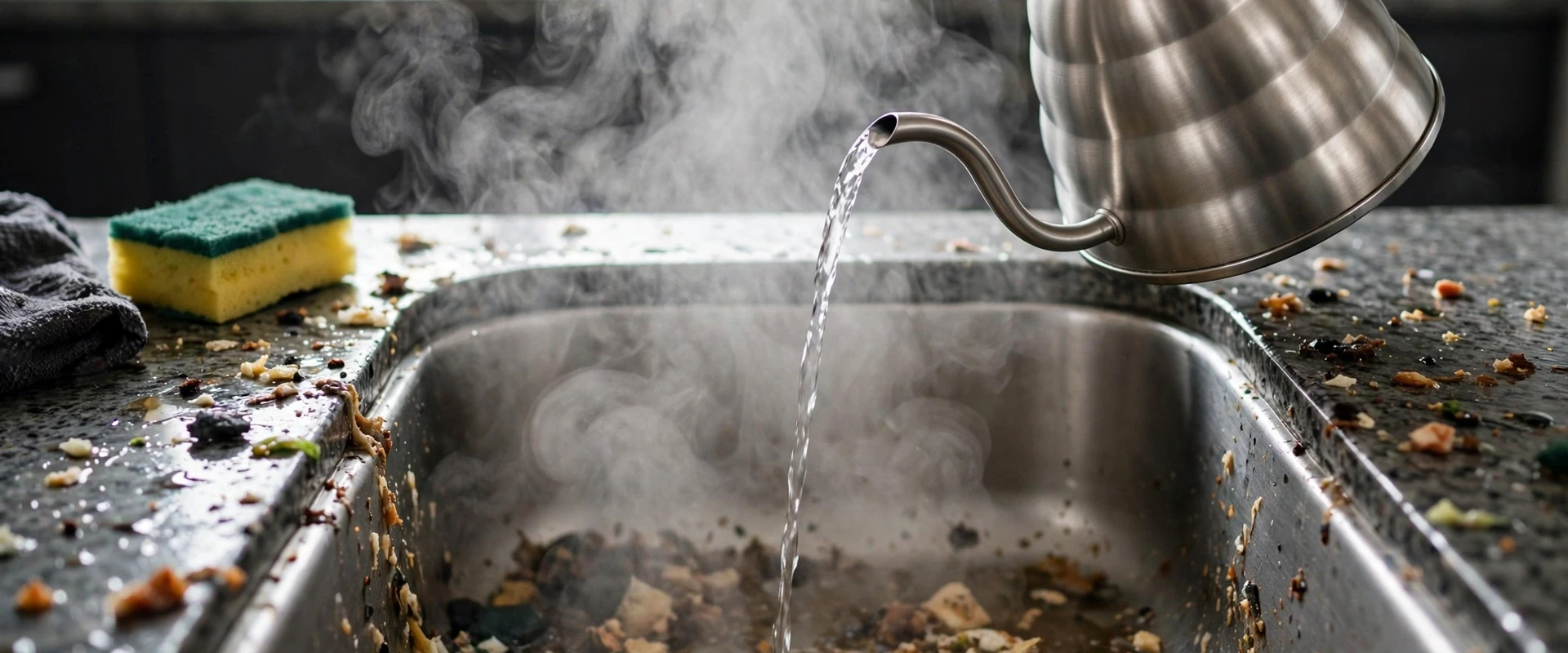
Boiling water works on one kind of clog. That is a recent buildup of cooking fat, soap film and food residue sitting in a short run of metal pipe, such as the tailpiece and trap under a kitchen sink. The heat turns solid fat back into liquid, and the liquid slides along with the flow.
It fails in a lot of other cases. Hair, wipes, paper, coffee grounds and food scraps do not melt. A clog that is already holding standing water cannot be treated by pouring more in. And grease that melts and travels further down the line cools again on a cold pipe wall, then sets up as a new plug somewhere you cannot reach.
So the honest answer is a decision, not a yes or no. What is the pipe made of, what is the clog made of, and is there standing water? The sections below walk through each one.
Why grease clogs respond to heat and other clogs do not
Cooking fat leaves the pan as a liquid. In the drain it cools, thickens and sticks to the pipe wall, where it catches coffee grounds, rice and bits of food. Over weeks the opening narrows from the walls inward. That is why a kitchen sink gets slow long before it stops.
Heat helps only while the water stays hot. Fat that melts at the trap will usually cool again a few feet downstream, because the cold pipe pulls the heat out of the water quickly. If the clog was thin, the melted fat carries on through to the larger line. If it was thick, you have only moved the problem out of sight.
Hair and wipes behave differently. Hair wraps around a stopper or a rough joint and forms a mat that hot water just flows around. Wipes and paper towels are built to survive water, and they are a leading cause of main line clogs. For those blockages the fix is mechanical, which means pulling or cutting the material out.
When boiling water does damage
Pipe material decides whether boiling water is safe. Metal drain lines such as cast iron, galvanized steel or copper handle it. Many homes today use PVC or ABS plastic for drain lines, and those plastics soften as they heat. General trade knowledge is that sustained very hot water can loosen glued joints and let a trap sag or leak, especially on older or thin fittings.
If you do not know what is under your sink, treat it as plastic. Use hot tap water, or very hot water that has stopped boiling for a minute, and pour it slowly rather than all at once. That is safer for PVC and still warm enough to help with a light grease film.
Porcelain and cast resin are the other casualties. A cold porcelain sink or tub that suddenly meets boiling water can crack from thermal shock. Never pour boiling water into a toilet. The bowl is a thick piece of vitrified china that does not flex, and a hairline crack there is a replacement, not a repair. Garbage disposals also dislike it, because the plastic and rubber parts near the outlet can warp.
| Situation | Boiling water okay? | Better first move |
|---|---|---|
| Slow kitchen sink, metal pipe, grease suspected | Yes, in a couple of careful pours | Hot tap water and dish soap first, then try again |
| Slow kitchen sink, plastic pipe or unknown | No, use hot tap water only | Plunge the sink, then clean the trap by hand |
| Bathroom sink or tub with hair | No, heat will not melt hair | Remove the stopper and pull out the hair, or use a hand auger |
| Toilet that will not flush | Never | Toilet plunger, then a toilet auger |
| Standing water in the sink | Cannot be poured in safely | Plunge or auger first, wait for the water to drain |
| Several drains slow or gurgling together | No, it will not reach the cause | Stop water use and call a plumber about the main line |
Safer things to try first
Start with the plunger. For a sink, block the overflow opening with a wet rag, put enough water in the basin to cover the cup of the plunger, and push down and pull up with steady strokes. Double sinks need the other side plugged too. Use a flat-bottomed sink plunger, not the flanged toilet one.
Next, clean the trap. Put a bucket under the U-shaped pipe, loosen the slip nuts by hand and empty it. Many kitchen clogs are sitting right there. Reassemble with the washers seated flat, run water, and look for drips at both nuts before you walk away.
If the clog is beyond the trap, a hand auger helps. A small drum auger runs a flexible cable into the branch, and you turn the handle so the tip hooks or breaks the plug. Go slowly, because forcing the cable around a bend can scratch a pipe or push the clog tighter.
A wet-dry vacuum is not recommended. People sometimes try to suck the clog out, but a household vacuum can pull sewage, gas and water into the motor, and most shop vacs make a poor seal on a drain opening.
What baking soda, vinegar and enzyme cleaners can and cannot do
Baking soda and vinegar fizz because the two react to make carbon dioxide and water. The bubbling is satisfying, but it has little force and no cutting action. It may loosen a light film of soap and grease at the trap, and it is gentle on pipes. It will not clear a hair mat, a wipe clog or a root intrusion, and the diluted liquid left behind is mostly water.
Enzymatic and bacterial cleaners work differently. They digest organic material such as grease, food and soap scum over hours or days. They suit slow maintenance, like a kitchen drain that gets sluggish every few months. They are not for an emergency, they cannot dissolve hair, plastic, or a solid wad of paper, and they work poorly in a drain that is fully blocked.
Chemical drain openers deserve a plain warning. Caustic products can sit in a stopped pipe and soften old fittings. They also leave dangerous standing water for whoever opens the line next. If you already used one, tell the plumber before the trap comes apart.
Tried the plunger and the trap and nothing moved?
Call the 24/7 line. A licensed plumber clears the line and you hear the price before work starts.
When the clog is bigger than one sink
A single slow fixture points to its own branch line. If the kitchen sink, dishwasher and a nearby bathroom all slow together, the shared branch is restricted. If every drain in the house is slow, a toilet bubbles when the washer drains, or water appears in a floor drain or shower, the blockage is in the main line. Boiling water will not help any of these, and it may add to the overflow.
At that point, stop running water, keep the toilet lids down and call. A plumber will use a cable machine through the cleanout, and often a camera to see what the cable met. Where grease or roots keep coming back, high pressure water scours the pipe wall, which is how high pressure water cleaning differs from a cable that only opens a hole through the plug.
Call a licensed plumber right away if sewage is coming up in a tub or shower, if water is spreading across a finished floor, or if you smell sewer gas. Do not mix cleaners, and do not use a lit flame near a drain that smells of gas. If you smell natural gas, leave the building and call 911 and the gas utility from a safe distance.
Boiling water, drains and sewers in Cibolo: what to know locally
Sewer billing in Cibolo changed in November 2025. According to the City of Cibolo, the City no longer bills sewer, and Green Valley Special Utility District (GVSUD) adds the sewer charge. For you, that means the utility on your bill is also the first call if the blockage might be in the public main.
GVSUD lists an emergency line for suspected sewer clogs at (830) 914-2331, and its main line is (830) 914-2330. If several drains in the house are backed up at once, or neighbors have the same trouble, use that emergency line. Hot water in your own sink cannot fix a blockage in the street main.
The City of Cibolo enforces the 2021 International Plumbing Code (IPC), which requires traps and vents on drains. A trap that is cracked or glued badly after a kettle accident should be repaired to that standard. Permit rules vary, so ask the City of Cibolo building department before work that opens walls or floors.
We also take drain calls in nearby towns such as Schertz and Converse, and the same material and clog logic applies there.
What to do before the plumber arrives
Stop adding water
Do not run the dishwasher or washer and skip flushing while the line is blocked, so nothing spills.
Do not add cleaners
Leave chemical openers on the shelf and tell the plumber about anything you already poured.
Clear the cabinet
Empty the space under the sink so the plumber can reach the trap and shutoff valves.
Note the pattern
Make a note of which fixtures are slow or gurgling, because that points to where the clog sits.
Common questions about boiling water and drains
It is better not to. General trade knowledge is that plastic pipe and glued joints soften with sustained heat, and a loosened joint may leak later. Use hot tap water, or very hot water that has stopped boiling, and pour it slowly.
Yes. Porcelain does not flex, and a sudden jump from cold to boiling can crack it. Never pour boiling water into a toilet. If a toilet is blocked, use a toilet plunger or a toilet auger instead.
The grease probably melted, moved down the line and set again on a cooler section of pipe. A cable can remove the plug, and if it keeps coming back, a plumber may suggest clearing the line properly with a camera check to see what is coating the pipe.
Rarely. The fizz can loosen a light film at the trap, but it cannot cut hair or move a wipe plug. It is a gentle maintenance step, not a rescue.
If you are a GVSUD customer, call its emergency line for suspected sewer clogs at (830) 914-2331. The City no longer bills sewer, so the bill tells you which utility to reach. If the public main is clear, our 24/7 line sends a licensed plumber for the house line.