
Why a drain clogs in the first place
A drain is a pipe that relies on gravity and a little momentum. Water carries small debris along, but anything that sticks to the wall of the pipe starts a collar that catches the next bit. The opening shrinks, flow slows, and slower flow drops more debris.
That is why partial clogs grow. A pipe two inches wide with a half-inch coating of grease and lint has lost about three quarters of its flow area. Every new scrap snags on the rough surface. The sink still drains, only slower, so most people ignore it until it quits.
Different fixtures build different clogs. The sections below go fixture by fixture, then to the main line.
Kitchen sink clogs
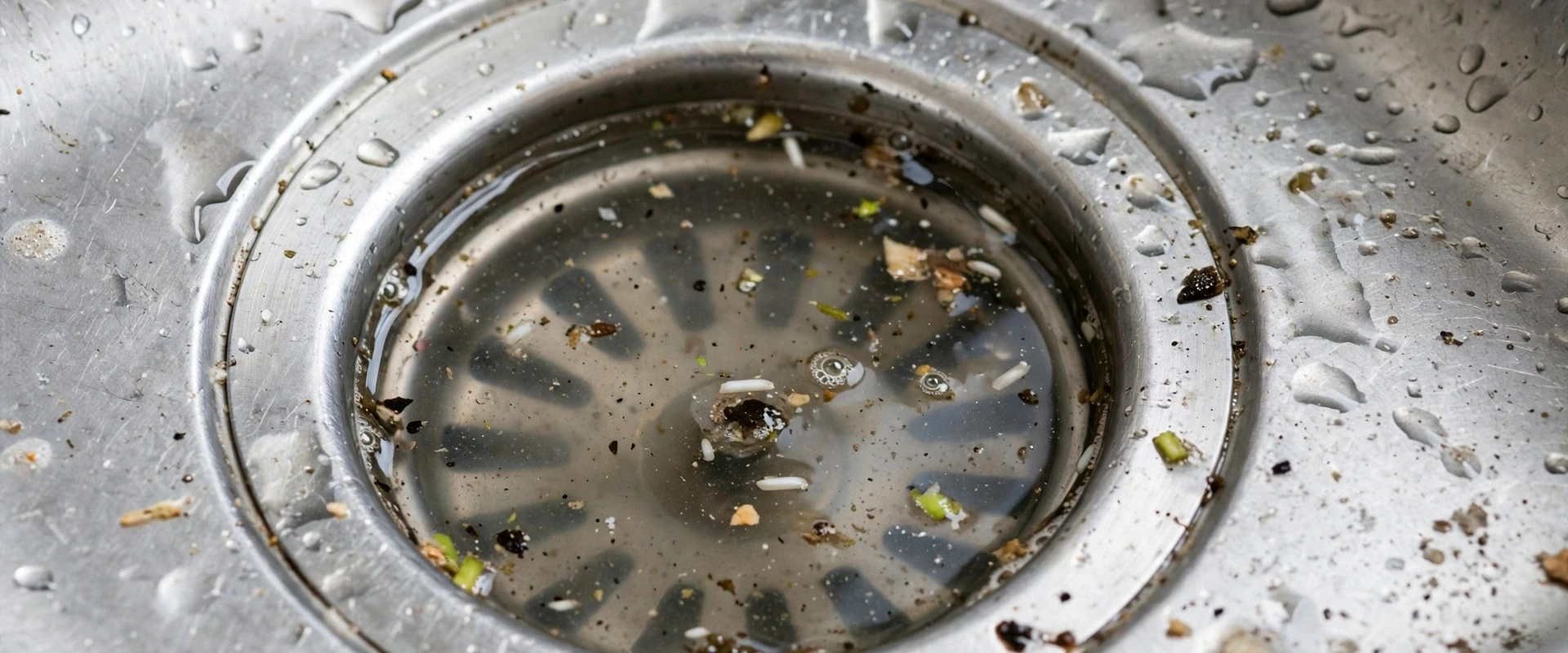
Grease is the first suspect. Cooking fat runs off the pan as a liquid, cools inside the trap and the horizontal pipe, and hardens into a waxy coat. Coffee grounds, rice, pasta and food scraps stick to it and form a dense plug. Hot water pushes the grease farther down the line where it cools again and sets.
Garbage disposals add to the problem. A disposal chops food into small pieces, but it does not dissolve them, and the fines settle in the outlet pipe and trap. Starchy foods swell, eggshell and coffee grounds pack down, and fibrous peels wrap around the pieces.
A kitchen drain that slows over weeks is almost always grease and food packed in the branch line. A disposal that hums or will not turn is a separate mechanical problem covered on the disposal repair page.
Bathroom sink, tub and shower clogs
Hair is the main cause. It wraps around the pop-up stopper or the drain crossbar and strings together with soap scum, toothpaste and skin oils into a gray mat. Cotton swabs, dental floss and small plastic caps do not break down, and they snag on the mat.
Soap scum itself is a fat-based film that clings to pipe walls and traps more hair. Tubs and showers clog more slowly than kitchen sinks, but the tangled mat is dense and often needs a cable or a hand tool to remove.
Pulling the stopper and cleaning it with a small tool or drain hook is often enough. If water pools around your feet after a thorough clean, the clog is deeper in the branch.
Toilet clogs
A toilet drain is about three inches wide, which handles waste and paper but not much else. Wipes are the leading cause of trouble, including wipes sold as flushable. They do not break up like toilet paper does. Paper towels, feminine products, cotton balls and too much toilet paper at one flush cause the rest.
Low-flow toilets rely on a well-shaped trap and a precise flush, and they leave little margin if you overload them. A toilet that clogs repeatedly with normal use may have a partial clog in the trap or just past it. A foreign object, such as a toy, can lodge in the trap and catch every flush after it.
Use a flange plunger, not a sink plunger, and never keep flushing a rising bowl. If plunging fails, a closet auger can reach the trap. A toilet that stays clogged is on the toilet repair side of the work.
Laundry drains
Lint is the culprit. Washers shed fibers that stick to grease and detergent residue in the standpipe and trap. The standpipe is small, often only two inches across, and has little room for buildup. The hose from the washer pumps water quickly, so a narrow standpipe can overflow when it clogs.
A lint trap on the washer hose and a clean-out of the standpipe now and then keep it open. If the washer overflows through the standpipe even after cleaning, the branch line behind the wall may be clogged.
Main line clogs
When every drain in the house is slow, or a shower fills when the washer drains, the blockage is in the main line. The common causes are wipes, grease that traveled from the kitchen, tree roots entering at a joint, and a sag in the pipe that holds water.
| Cause | How it forms | What it usually needs |
|---|---|---|
| Wipes and paper | Snag on rough joints and bunch up | Cable or jetting |
| Roots | Grow into joints seeking moisture | Cutting, then repair if the joint is open |
| Belly (sag) | Soil settles and the pipe dips | Camera, then repair or replacement |
| Offset joint | Two sections shift out of line | Camera, then repair |
| Scale buildup | Mineral deposits on pipe walls | Descaling or jetting |
| Collapsed pipe | Old or crushed pipe fails | Repair or replacement |
A cable can clear a soft plug but cannot fix a belly, an offset or a collapsed pipe. Clearing roots without fixing the open joint only buys time. That is why a plumber often adds a camera look after clearing, and the main line cleaning page describes the order of work.
Reading the symptoms
The pattern points to the cause before anyone picks up a tool.
One fixture slow
A clog in that fixture's own trap or branch. Hair, grease or soap scum is most likely.
Two fixtures on the same floor
A shared branch line is narrowing.
Gurgling when another fixture drains
Air is being pulled through a partial clog or a vent problem.
Every drain slow
The main line is partly blocked, or there is a vent or public sewer problem.
Water coming up in the lowest drain
The main line is blocked. Treat it as urgent.
What drain products do and do not do
Plungers and hand augers are the safe first tools for a single fixture. Enzyme cleaners digest some organic buildup slowly and are safe for pipes, though they will not break a solid plug.
Caustic liquid cleaners are riskier. They work by generating heat or reacting with the clog, and in a fully blocked pipe they sit there. That can soften old pipe and joints, and it makes standing water dangerous for the next person who opens the pipe. If you used one, tell the plumber. Never mix cleaners, because some combinations release toxic fumes.
Clog that keeps coming back?
Call the 24/7 line. A licensed plumber can clear it and check what is behind it, and you hear the price before work starts.
Habits that prevent most clogs
Wipe grease from pans into the trash before washing. Use a mesh strainer in every sink and shower. Run hot water for a few moments after washing dishes. Keep wipes, floss, cotton swabs and paper towels out of the toilet. Run the disposal with cold water and avoid starches and fibrous scraps. Clean the stoppers when you see a slow drain, not when the water stops.
These habits matter more than any product. If the same sink clogs every few months despite them, the pipe wall may be coated, and high pressure water cleaning can scour it. If you hear gurgling in several drains, stop adding water and call a licensed plumber.
Clogged drains and the sewer in Cibolo: what to know locally
According to the City of Cibolo, the City stopped billing sewer in November 2025, and Green Valley Special Utility District (GVSUD) adds the sewer charge. That matters when every drain in the house backs up at once, because the blockage could be in your own line or in the public main. GVSUD lists an emergency line for suspected sewer clogs at (830) 914-2331.
If neighbors have the same symptoms or a manhole near you is overflowing, call GVSUD first. If only your home is affected, a plumber with a camera can tell which side of the property line holds the blockage. Settle ownership first, because it decides who pays.
Roots are a general plumbing fact. Trees send roots toward moisture, and a small crack or loose joint in a sewer line gives them a way in. We do not know which species are common in Cibolo, so a camera inspection is the only way to learn what is in your line.
Questions about clogged drains in Cibolo
Grease and food scraps coat the pipe wall and catch new debris. A cable opens the pipe but often leaves the coating behind. If it returns within months, ask about cleaning the pipe wall.
They are not a safe bet. They do not break apart like toilet paper and snag in pipes. Bin them.
Slow drains throughout the house, repeated clogs and gurgling are clues. A camera inspection shows roots directly.
It depends where the blockage sits. If neighbors are affected, call GVSUD at (830) 914-2331. A plumber can check which side of the property line the clog is on.
Since November 2025 the City of Cibolo no longer bills sewer, and GVSUD adds the sewer charge. GVSUD's emergency line for suspected sewer clogs is (830) 914-2331, and its main line is (830) 914-2330.